> ## Documentation Index
> Fetch the complete documentation index at: https://resources.devweekends.com/llms.txt
> Use this file to discover all available pages before exploring further.
# Replication Strategies
> Single-leader, multi-leader, and leaderless replication patterns
 # Track 3: Replication Strategies
How to copy data across nodes while maintaining consistency guarantees. Replication is the foundation of both reliability and performance in distributed systems -- it ensures your data survives machine failures and allows read traffic to be spread across multiple servers. But it comes with a fundamental tension: the more copies you maintain, the harder it is to keep them all in sync, especially when the network is slow or partitioned.
**Track Duration**: 38-46 hours\
**Modules**: 5\
**Key Topics**: Single-leader, Multi-leader, Leaderless, Conflict Resolution, CRDTs
***
## Module 11: Single-Leader Replication
The most common replication strategy.
# Track 3: Replication Strategies
How to copy data across nodes while maintaining consistency guarantees. Replication is the foundation of both reliability and performance in distributed systems -- it ensures your data survives machine failures and allows read traffic to be spread across multiple servers. But it comes with a fundamental tension: the more copies you maintain, the harder it is to keep them all in sync, especially when the network is slow or partitioned.
**Track Duration**: 38-46 hours\
**Modules**: 5\
**Key Topics**: Single-leader, Multi-leader, Leaderless, Conflict Resolution, CRDTs
***
## Module 11: Single-Leader Replication
The most common replication strategy.
 ```
┌─────────────────────────────────────────────────────────────────────────────┐
│ SINGLE-LEADER REPLICATION │
├─────────────────────────────────────────────────────────────────────────────┤
│ │
│ ┌─────────────┐ │
│ Writes ────►│ LEADER │ │
│ │ (Primary) │ │
│ └──────┬──────┘ │
│ │ │
│ ┌──────────┼──────────┐ │
│ │ │ │ │
│ ▼ ▼ ▼ │
│ ┌─────────┐┌─────────┐┌─────────┐ │
│ Reads ◄───►│Follower ││Follower ││Follower │◄───► Reads │
│ │ 1 ││ 2 ││ 3 │ │
│ └─────────┘└─────────┘└─────────┘ │
│ │
│ FLOW: │
│ ───── │
│ 1. Client writes to leader only │
│ 2. Leader persists write │
│ 3. Leader sends write to all followers │
│ 4. Followers apply write │
│ 5. Reads can go to any replica │
│ │
│ DATABASES: PostgreSQL, MySQL, MongoDB, Redis │
│ │
└─────────────────────────────────────────────────────────────────────────────┘
```
### Synchronous vs Asynchronous Replication
Leader waits for follower acknowledgment before confirming write.
```
Client Leader Follower
│ │ │
│──Write──► │
│ │──Replicate─►
│ │◄───ACK─────│
│◄──OK────│ │
│ │ │
Time: Longer (network + follower persist)
```
**Pros**:
* Follower guaranteed to be up-to-date
* No data loss on leader failure
**Cons**:
* Higher latency
* Leader blocked if follower slow/dead
Leader confirms write immediately, replicates in background.
```
Client Leader Follower
│ │ │
│──Write──► │
│◄──OK────│ │
│ │──Replicate─►
│ │◄───ACK─────│
│ │ │
Time: Short (just leader persist)
```
**Pros**:
* Lower latency
* Leader not blocked by slow followers
**Cons**:
* **Data loss possible** if leader fails before replication
* Followers may serve stale data
Wait for at least one follower (best of both worlds).
```
MySQL: One sync follower, rest async
PostgreSQL: synchronous_commit settings
```
**Configuration**:
* `synchronous_standby_names = 'FIRST 1 (f1, f2, f3)'`
* Wait for first follower to ack
* Others replicate asynchronously
**Pros**:
* No data loss (at least 2 copies)
* Better latency than full sync
### Replication Lag
```
┌─────────────────────────────────────────────────────────────────────────────┐
│ REPLICATION LAG │
├─────────────────────────────────────────────────────────────────────────────┤
│ │
│ Leader: [1] [2] [3] [4] [5] [6] [7] [8] │
│ Follower: [1] [2] [3] [4] [5] ← 3 entries behind │
│ │
│ PROBLEMS THIS CAUSES: │
│ ───────────────────── │
│ │
│ 1. READ-YOUR-WRITES VIOLATION │
│ User writes, immediately reads from follower → doesn't see write! │
│ │
│ 2. MONOTONIC READS VIOLATION │
│ User reads from F1, then F2 (further behind) → data "goes backward" │
│ │
│ 3. CONSISTENT PREFIX VIOLATION │
└─────────────────────────────────────────────────────────────────────────────┘
```
### Understanding Replication Lag
Replication lag is the time delay between when a write occurs on the leader and when it's applied on a follower. The diagram above shows a 150ms lag where the follower is consistently behind the leader.
**Why Lag Happens** (and why you cannot eliminate it entirely):
* **Network latency** between leader and followers -- speed-of-light physics; a cross-region replica 5000km away has at minimum \~17ms RTT just from physics
* **Follower processing** slower than leader writes -- the follower must apply writes in order, and a single slow query (e.g., index rebuild) stalls everything behind it
* **Follower temporarily offline** or restarting -- when it comes back, it must replay the entire backlog before it is "caught up"
* **High write throughput** overwhelming followers -- if the leader can write at 100K TPS but the follower's disk can only sustain 80K TPS, the gap grows monotonically until you intervene
**Measuring Lag**:
```sql theme={null}
-- PostgreSQL: Check replication lag
SELECT
client_addr,
state,
pg_wal_lsn_diff(pg_current_wal_lsn(), sent_lsn) AS pending_bytes,
pg_wal_lsn_diff(pg_current_wal_lsn(), replay_lsn) AS lag_bytes
FROM pg_stat_replication;
```
**Acceptable Lag**: Depends on your use case
* **Financial systems**: Milliseconds
* **Analytics**: Minutes or hours acceptable
* **Caching**: Seconds to minutes
**Solutions to Lag Problems**:
* **Sticky sessions**: Route user's reads to same follower
* **Read from leader**: For critical reads after writes
* **Version vectors**: Track causality explicitly
### Implementing Read-Your-Writes Guarantees
One of the most common consistency issues users experience. Here's how to implement it:
```
┌─────────────────────────────────────────────────────────────────────────────┐
│ READ-YOUR-WRITES IMPLEMENTATION │
├─────────────────────────────────────────────────────────────────────────────┤
│ │
│ PROBLEM: │
│ User writes to leader, immediately reads from follower → stale data! │
│ │
│ Client ──Write──► Leader (v5) │
│ Client ──Read───► Follower (still at v3) → "Where's my data?!" │
│ │
│ ═══════════════════════════════════════════════════════════════════════ │
│ │
│ SOLUTION 1: STICKY SESSIONS (Simple) │
│ ───────────────────────────────────── │
│ Route all requests from same user to same replica │
│ • Use user_id hash for routing │
│ • Works if replica is leader or caught-up follower │
│ • Breaks on failover │
│ │
│ SOLUTION 2: READ-FROM-LEADER (Strong but bottleneck) │
│ ──────────────────────────────────────────────────── │
│ After write, read from leader for X seconds │
│ • Simple to implement │
│ • Increases leader load │
│ • Time-based heuristic (may still serve stale) │
│ │
│ SOLUTION 3: VERSION TRACKING (Robust) │
│ ───────────────────────────────────── │
│ Track write version, ensure read version ≥ write version │
│ │
└─────────────────────────────────────────────────────────────────────────────┘
```
**Production Implementation (Version Tracking)**:
```python theme={null}
class ReadYourWritesClient:
"""
Client-side implementation of Read-Your-Writes guarantee.
Used by: MongoDB, CockroachDB, Spanner
"""
def __init__(self):
# Track the latest write version per key (or global)
self.write_version = {} # key -> version
def write(self, key, value):
"""Write to leader, record version"""
response = self.leader.write(key, value)
# Store the version returned by leader
self.write_version[key] = response.version
return response
def read(self, key):
"""Read ensuring we see our writes"""
min_version = self.write_version.get(key, 0)
# Option A: Send min_version to replica, it waits until caught up
response = self.replica.read(
key,
min_version=min_version # "Don't respond until you have this version"
)
# Option B: Read from any replica, retry if stale
for replica in self.replicas:
response = replica.read(key)
if response.version >= min_version:
return response
# Fallback to leader if no replica is fresh enough
return self.leader.read(key)
class ReplicaServer:
"""Server-side: Wait for replication before responding"""
def read(self, key, min_version=None):
if min_version is not None:
# Wait until we've replicated up to min_version
self.wait_for_version(min_version, timeout=5.0)
return self.storage.get(key)
def wait_for_version(self, target_version, timeout):
"""Block until replication catches up"""
start = time.time()
while self.current_version < target_version:
if time.time() - start > timeout:
raise StaleReadError("Replica too far behind")
time.sleep(0.01) # Busy wait (use condition variable in prod)
```
**Comparison of Approaches**:
| Approach | Consistency | Availability | Complexity |
| ---------------- | ----------- | ------------ | ---------- |
| Sticky Sessions | Weak | High | Low |
| Read-from-Leader | Strong | Lower | Low |
| Version Tracking | Strong | High | Medium |
| Causal Tokens | Strong | High | High |
**Causal Consistency Tokens** (Advanced):
Systems like MongoDB use "causal consistency tokens" that encode the entire causal history, not just a single version. This ensures you see all causally-related writes, not just your own.
```python theme={null}
# MongoDB-style causal token
{
"clusterTime": {"$timestamp": {"t": 1624000000, "i": 1}},
"operationTime": {"$timestamp": {"t": 1624000000, "i": 1}},
"afterClusterTime": {"$timestamp": {"t": 1623999999, "i": 5}}
}
```
***
### Handling Failover
│ │
│ STEP 1: DETECT LEADER FAILURE │
│ ───────────────────────────── │
│ • Heartbeat timeout (typically 10-30 seconds) │
│ • Multiple checks to avoid false positives │
│ │
│ STEP 2: ELECT NEW LEADER │
│ ──────────────────────── │
│ • Most up-to-date follower preferred │
│ • May use consensus (Raft) or controller node │
│ │
│ STEP 3: RECONFIGURE SYSTEM │
│ ───────────────────────── │
│ • Update clients to write to new leader │
│ • Other followers switch to new leader │
│ • DNS/load balancer update │
│ │
│ GOTCHAS: │
│ ──────── │
│ ┌──────────────────────────────────────────────────────────────────┐ │
│ │ SPLIT-BRAIN: Both old and new leader think they're the leader │ │
│ │ DATA LOSS: Async replication means new leader may be behind │ │
│ │ CONFLICTS: Old leader comes back with conflicting writes │ │
│ └──────────────────────────────────────────────────────────────────┘ │
│ │
│ GITHUB 2012 INCIDENT: │
│ MySQL failover caused data loss │
│ Auto-incrementing IDs reused → foreign key violations │
│ │
└─────────────────────────────────────────────────────────────────────────────┘
```
---
## Module 12: Multi-Leader Replication
When a single leader isn't enough.
```
┌─────────────────────────────────────────────────────────────────────────────┐
│ SINGLE-LEADER REPLICATION │
├─────────────────────────────────────────────────────────────────────────────┤
│ │
│ ┌─────────────┐ │
│ Writes ────►│ LEADER │ │
│ │ (Primary) │ │
│ └──────┬──────┘ │
│ │ │
│ ┌──────────┼──────────┐ │
│ │ │ │ │
│ ▼ ▼ ▼ │
│ ┌─────────┐┌─────────┐┌─────────┐ │
│ Reads ◄───►│Follower ││Follower ││Follower │◄───► Reads │
│ │ 1 ││ 2 ││ 3 │ │
│ └─────────┘└─────────┘└─────────┘ │
│ │
│ FLOW: │
│ ───── │
│ 1. Client writes to leader only │
│ 2. Leader persists write │
│ 3. Leader sends write to all followers │
│ 4. Followers apply write │
│ 5. Reads can go to any replica │
│ │
│ DATABASES: PostgreSQL, MySQL, MongoDB, Redis │
│ │
└─────────────────────────────────────────────────────────────────────────────┘
```
### Synchronous vs Asynchronous Replication
Leader waits for follower acknowledgment before confirming write.
```
Client Leader Follower
│ │ │
│──Write──► │
│ │──Replicate─►
│ │◄───ACK─────│
│◄──OK────│ │
│ │ │
Time: Longer (network + follower persist)
```
**Pros**:
* Follower guaranteed to be up-to-date
* No data loss on leader failure
**Cons**:
* Higher latency
* Leader blocked if follower slow/dead
Leader confirms write immediately, replicates in background.
```
Client Leader Follower
│ │ │
│──Write──► │
│◄──OK────│ │
│ │──Replicate─►
│ │◄───ACK─────│
│ │ │
Time: Short (just leader persist)
```
**Pros**:
* Lower latency
* Leader not blocked by slow followers
**Cons**:
* **Data loss possible** if leader fails before replication
* Followers may serve stale data
Wait for at least one follower (best of both worlds).
```
MySQL: One sync follower, rest async
PostgreSQL: synchronous_commit settings
```
**Configuration**:
* `synchronous_standby_names = 'FIRST 1 (f1, f2, f3)'`
* Wait for first follower to ack
* Others replicate asynchronously
**Pros**:
* No data loss (at least 2 copies)
* Better latency than full sync
### Replication Lag
```
┌─────────────────────────────────────────────────────────────────────────────┐
│ REPLICATION LAG │
├─────────────────────────────────────────────────────────────────────────────┤
│ │
│ Leader: [1] [2] [3] [4] [5] [6] [7] [8] │
│ Follower: [1] [2] [3] [4] [5] ← 3 entries behind │
│ │
│ PROBLEMS THIS CAUSES: │
│ ───────────────────── │
│ │
│ 1. READ-YOUR-WRITES VIOLATION │
│ User writes, immediately reads from follower → doesn't see write! │
│ │
│ 2. MONOTONIC READS VIOLATION │
│ User reads from F1, then F2 (further behind) → data "goes backward" │
│ │
│ 3. CONSISTENT PREFIX VIOLATION │
└─────────────────────────────────────────────────────────────────────────────┘
```
### Understanding Replication Lag
Replication lag is the time delay between when a write occurs on the leader and when it's applied on a follower. The diagram above shows a 150ms lag where the follower is consistently behind the leader.
**Why Lag Happens** (and why you cannot eliminate it entirely):
* **Network latency** between leader and followers -- speed-of-light physics; a cross-region replica 5000km away has at minimum \~17ms RTT just from physics
* **Follower processing** slower than leader writes -- the follower must apply writes in order, and a single slow query (e.g., index rebuild) stalls everything behind it
* **Follower temporarily offline** or restarting -- when it comes back, it must replay the entire backlog before it is "caught up"
* **High write throughput** overwhelming followers -- if the leader can write at 100K TPS but the follower's disk can only sustain 80K TPS, the gap grows monotonically until you intervene
**Measuring Lag**:
```sql theme={null}
-- PostgreSQL: Check replication lag
SELECT
client_addr,
state,
pg_wal_lsn_diff(pg_current_wal_lsn(), sent_lsn) AS pending_bytes,
pg_wal_lsn_diff(pg_current_wal_lsn(), replay_lsn) AS lag_bytes
FROM pg_stat_replication;
```
**Acceptable Lag**: Depends on your use case
* **Financial systems**: Milliseconds
* **Analytics**: Minutes or hours acceptable
* **Caching**: Seconds to minutes
**Solutions to Lag Problems**:
* **Sticky sessions**: Route user's reads to same follower
* **Read from leader**: For critical reads after writes
* **Version vectors**: Track causality explicitly
### Implementing Read-Your-Writes Guarantees
One of the most common consistency issues users experience. Here's how to implement it:
```
┌─────────────────────────────────────────────────────────────────────────────┐
│ READ-YOUR-WRITES IMPLEMENTATION │
├─────────────────────────────────────────────────────────────────────────────┤
│ │
│ PROBLEM: │
│ User writes to leader, immediately reads from follower → stale data! │
│ │
│ Client ──Write──► Leader (v5) │
│ Client ──Read───► Follower (still at v3) → "Where's my data?!" │
│ │
│ ═══════════════════════════════════════════════════════════════════════ │
│ │
│ SOLUTION 1: STICKY SESSIONS (Simple) │
│ ───────────────────────────────────── │
│ Route all requests from same user to same replica │
│ • Use user_id hash for routing │
│ • Works if replica is leader or caught-up follower │
│ • Breaks on failover │
│ │
│ SOLUTION 2: READ-FROM-LEADER (Strong but bottleneck) │
│ ──────────────────────────────────────────────────── │
│ After write, read from leader for X seconds │
│ • Simple to implement │
│ • Increases leader load │
│ • Time-based heuristic (may still serve stale) │
│ │
│ SOLUTION 3: VERSION TRACKING (Robust) │
│ ───────────────────────────────────── │
│ Track write version, ensure read version ≥ write version │
│ │
└─────────────────────────────────────────────────────────────────────────────┘
```
**Production Implementation (Version Tracking)**:
```python theme={null}
class ReadYourWritesClient:
"""
Client-side implementation of Read-Your-Writes guarantee.
Used by: MongoDB, CockroachDB, Spanner
"""
def __init__(self):
# Track the latest write version per key (or global)
self.write_version = {} # key -> version
def write(self, key, value):
"""Write to leader, record version"""
response = self.leader.write(key, value)
# Store the version returned by leader
self.write_version[key] = response.version
return response
def read(self, key):
"""Read ensuring we see our writes"""
min_version = self.write_version.get(key, 0)
# Option A: Send min_version to replica, it waits until caught up
response = self.replica.read(
key,
min_version=min_version # "Don't respond until you have this version"
)
# Option B: Read from any replica, retry if stale
for replica in self.replicas:
response = replica.read(key)
if response.version >= min_version:
return response
# Fallback to leader if no replica is fresh enough
return self.leader.read(key)
class ReplicaServer:
"""Server-side: Wait for replication before responding"""
def read(self, key, min_version=None):
if min_version is not None:
# Wait until we've replicated up to min_version
self.wait_for_version(min_version, timeout=5.0)
return self.storage.get(key)
def wait_for_version(self, target_version, timeout):
"""Block until replication catches up"""
start = time.time()
while self.current_version < target_version:
if time.time() - start > timeout:
raise StaleReadError("Replica too far behind")
time.sleep(0.01) # Busy wait (use condition variable in prod)
```
**Comparison of Approaches**:
| Approach | Consistency | Availability | Complexity |
| ---------------- | ----------- | ------------ | ---------- |
| Sticky Sessions | Weak | High | Low |
| Read-from-Leader | Strong | Lower | Low |
| Version Tracking | Strong | High | Medium |
| Causal Tokens | Strong | High | High |
**Causal Consistency Tokens** (Advanced):
Systems like MongoDB use "causal consistency tokens" that encode the entire causal history, not just a single version. This ensures you see all causally-related writes, not just your own.
```python theme={null}
# MongoDB-style causal token
{
"clusterTime": {"$timestamp": {"t": 1624000000, "i": 1}},
"operationTime": {"$timestamp": {"t": 1624000000, "i": 1}},
"afterClusterTime": {"$timestamp": {"t": 1623999999, "i": 5}}
}
```
***
### Handling Failover
│ │
│ STEP 1: DETECT LEADER FAILURE │
│ ───────────────────────────── │
│ • Heartbeat timeout (typically 10-30 seconds) │
│ • Multiple checks to avoid false positives │
│ │
│ STEP 2: ELECT NEW LEADER │
│ ──────────────────────── │
│ • Most up-to-date follower preferred │
│ • May use consensus (Raft) or controller node │
│ │
│ STEP 3: RECONFIGURE SYSTEM │
│ ───────────────────────── │
│ • Update clients to write to new leader │
│ • Other followers switch to new leader │
│ • DNS/load balancer update │
│ │
│ GOTCHAS: │
│ ──────── │
│ ┌──────────────────────────────────────────────────────────────────┐ │
│ │ SPLIT-BRAIN: Both old and new leader think they're the leader │ │
│ │ DATA LOSS: Async replication means new leader may be behind │ │
│ │ CONFLICTS: Old leader comes back with conflicting writes │ │
│ └──────────────────────────────────────────────────────────────────┘ │
│ │
│ GITHUB 2012 INCIDENT: │
│ MySQL failover caused data loss │
│ Auto-incrementing IDs reused → foreign key violations │
│ │
└─────────────────────────────────────────────────────────────────────────────┘
```
---
## Module 12: Multi-Leader Replication
When a single leader isn't enough.
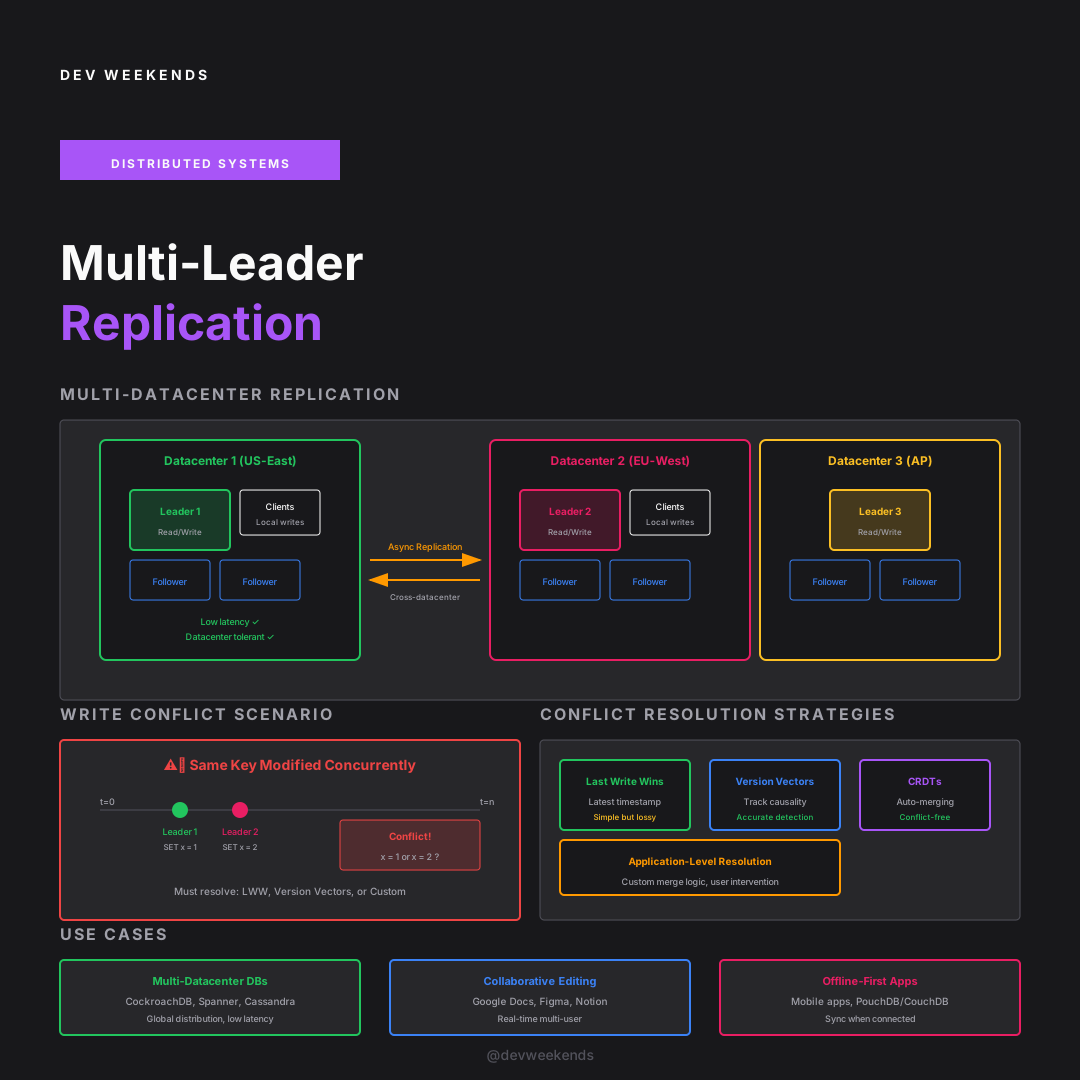 ```
┌─────────────────────────────────────────────────────────────────────────────┐
│ MULTI-LEADER REPLICATION │
├─────────────────────────────────────────────────────────────────────────────┤
│ │
│ Datacenter A │ Datacenter B │
│ │ │
│ ┌──────────────┐ │ ┌──────────────┐ │
│ │ Leader A │◄────────────┼────────►│ Leader B │ │
│ └──────┬───────┘ Async │ └──────┬───────┘ │
│ │ Sync │ │ │
│ ┌─────┴─────┐ │ ┌─────┴─────┐ │
│ ▼ ▼ │ ▼ ▼ │
│ ┌────────┐ ┌────────┐ │ ┌────────┐ ┌────────┐ │
│ │Follower│ │Follower│ │ │Follower│ │Follower│ │
│ └────────┘ └────────┘ │ └────────┘ └────────┘ │
│ │ │
│ Clients ───► Local Leader │ Clients ───► Local Leader │
│ │ │
└─────────────────────────────────────────────────────────────────────────────┘
USE CASES:
──────────
1. Multi-datacenter operation (write locally, replicate globally)
\-- This is the most common. Write latency stays local (\~1-5ms instead
of cross-continent \~100-200ms). Trade-off: conflicts.
2. Offline-capable clients (phone writes locally, syncs later)
\-- CouchDB and PouchDB were designed specifically for this pattern.
Your phone is essentially a "leader" that syncs when connectivity returns.
3. Collaborative editing (each user has local leader)
\-- Google Docs uses a variant of this combined with Operational Transform.
WARNING: Multi-leader replication is one of the most conflict-prone patterns
in distributed systems. Only use it when the latency or availability benefits
clearly outweigh the complexity of conflict resolution. If you can tolerate
routing all writes through a single leader (even with higher latency), do that
instead -- it is dramatically simpler to reason about.
```
### Conflict Detection and Resolution
```
CONFLICT SCENARIO:
──────────────────
Time Leader A Leader B
──── ──────── ────────
t1 x = 1 x = 1 (Initial state)
t2 x = 2 x = 3 (Concurrent writes!)
t3 (replicate) ────────────── (replicate)
t4 x = 2 AND 3? x = 3 AND 2? CONFLICT!
WHEN TO DETECT:
───────────────
• Synchronous: Detect immediately (if possible)
• Asynchronous: Detect during replication (too late to reject)
Most multi-leader systems detect asynchronously
→ must resolve conflicts after the fact
```
```
1. LAST-WRITE-WINS (LWW)
────────────────────────
Use timestamps, highest timestamp wins
Problem: Data loss (other write silently discarded)
Problem: Clock skew can cause "wrong" winner
Used by: Cassandra, DynamoDB (default)
2. MERGE VALUES
────────────────
Combine conflicting values
x = 2 + x = 3 → x = \[2, 3]
Problem: Not always semantically meaningful
3. CUSTOM RESOLUTION
────────────────────
Application-specific logic
Example: For shopping cart, union of items
Example: For counter, add the deltas
4. PROMPT USER
──────────────
Show conflicts to user, let them choose
Used by: Git, some CMS systems
```
```
BEST STRATEGY: Avoid conflicts in the first place
TECHNIQUES:
───────────
1. ROUTE BY USER
User's writes always go to same leader
No concurrent writes to same data
2. ROUTE BY DATA
Partition data, each partition has one leader
3. GLOBAL LOCKING
Acquire lock before write
(defeats purpose of multi-leader though)
4. CRDT DATA TYPES
Data structures designed to merge without conflicts
(covered in Module 15)
```
### Conflict Scenarios Visualized

**Real-World Example**: Google Docs
Google Docs uses multi-leader replication (operational transformation, similar to CRDTs):
- Each user's browser is a "leader"
- Concurrent edits to same document
- Conflicts resolved automatically through OT algorithm
- Users see each other's changes in real-time
**When Multi-Leader Makes Sense**:
1. **Geographic Distribution**: Users in different continents
2. **Offline Operation**: Mobile apps that sync later
3. **Collaborative Editing**: Multiple users editing simultaneously
4. **High Availability**: No single point of failure
---
## Module 13: Leaderless Replication
The Dynamo-style approach.
```
┌─────────────────────────────────────────────────────────────────────────────┐
│ MULTI-LEADER REPLICATION │
├─────────────────────────────────────────────────────────────────────────────┤
│ │
│ Datacenter A │ Datacenter B │
│ │ │
│ ┌──────────────┐ │ ┌──────────────┐ │
│ │ Leader A │◄────────────┼────────►│ Leader B │ │
│ └──────┬───────┘ Async │ └──────┬───────┘ │
│ │ Sync │ │ │
│ ┌─────┴─────┐ │ ┌─────┴─────┐ │
│ ▼ ▼ │ ▼ ▼ │
│ ┌────────┐ ┌────────┐ │ ┌────────┐ ┌────────┐ │
│ │Follower│ │Follower│ │ │Follower│ │Follower│ │
│ └────────┘ └────────┘ │ └────────┘ └────────┘ │
│ │ │
│ Clients ───► Local Leader │ Clients ───► Local Leader │
│ │ │
└─────────────────────────────────────────────────────────────────────────────┘
USE CASES:
──────────
1. Multi-datacenter operation (write locally, replicate globally)
\-- This is the most common. Write latency stays local (\~1-5ms instead
of cross-continent \~100-200ms). Trade-off: conflicts.
2. Offline-capable clients (phone writes locally, syncs later)
\-- CouchDB and PouchDB were designed specifically for this pattern.
Your phone is essentially a "leader" that syncs when connectivity returns.
3. Collaborative editing (each user has local leader)
\-- Google Docs uses a variant of this combined with Operational Transform.
WARNING: Multi-leader replication is one of the most conflict-prone patterns
in distributed systems. Only use it when the latency or availability benefits
clearly outweigh the complexity of conflict resolution. If you can tolerate
routing all writes through a single leader (even with higher latency), do that
instead -- it is dramatically simpler to reason about.
```
### Conflict Detection and Resolution
```
CONFLICT SCENARIO:
──────────────────
Time Leader A Leader B
──── ──────── ────────
t1 x = 1 x = 1 (Initial state)
t2 x = 2 x = 3 (Concurrent writes!)
t3 (replicate) ────────────── (replicate)
t4 x = 2 AND 3? x = 3 AND 2? CONFLICT!
WHEN TO DETECT:
───────────────
• Synchronous: Detect immediately (if possible)
• Asynchronous: Detect during replication (too late to reject)
Most multi-leader systems detect asynchronously
→ must resolve conflicts after the fact
```
```
1. LAST-WRITE-WINS (LWW)
────────────────────────
Use timestamps, highest timestamp wins
Problem: Data loss (other write silently discarded)
Problem: Clock skew can cause "wrong" winner
Used by: Cassandra, DynamoDB (default)
2. MERGE VALUES
────────────────
Combine conflicting values
x = 2 + x = 3 → x = \[2, 3]
Problem: Not always semantically meaningful
3. CUSTOM RESOLUTION
────────────────────
Application-specific logic
Example: For shopping cart, union of items
Example: For counter, add the deltas
4. PROMPT USER
──────────────
Show conflicts to user, let them choose
Used by: Git, some CMS systems
```
```
BEST STRATEGY: Avoid conflicts in the first place
TECHNIQUES:
───────────
1. ROUTE BY USER
User's writes always go to same leader
No concurrent writes to same data
2. ROUTE BY DATA
Partition data, each partition has one leader
3. GLOBAL LOCKING
Acquire lock before write
(defeats purpose of multi-leader though)
4. CRDT DATA TYPES
Data structures designed to merge without conflicts
(covered in Module 15)
```
### Conflict Scenarios Visualized

**Real-World Example**: Google Docs
Google Docs uses multi-leader replication (operational transformation, similar to CRDTs):
- Each user's browser is a "leader"
- Concurrent edits to same document
- Conflicts resolved automatically through OT algorithm
- Users see each other's changes in real-time
**When Multi-Leader Makes Sense**:
1. **Geographic Distribution**: Users in different continents
2. **Offline Operation**: Mobile apps that sync later
3. **Collaborative Editing**: Multiple users editing simultaneously
4. **High Availability**: No single point of failure
---
## Module 13: Leaderless Replication
The Dynamo-style approach.
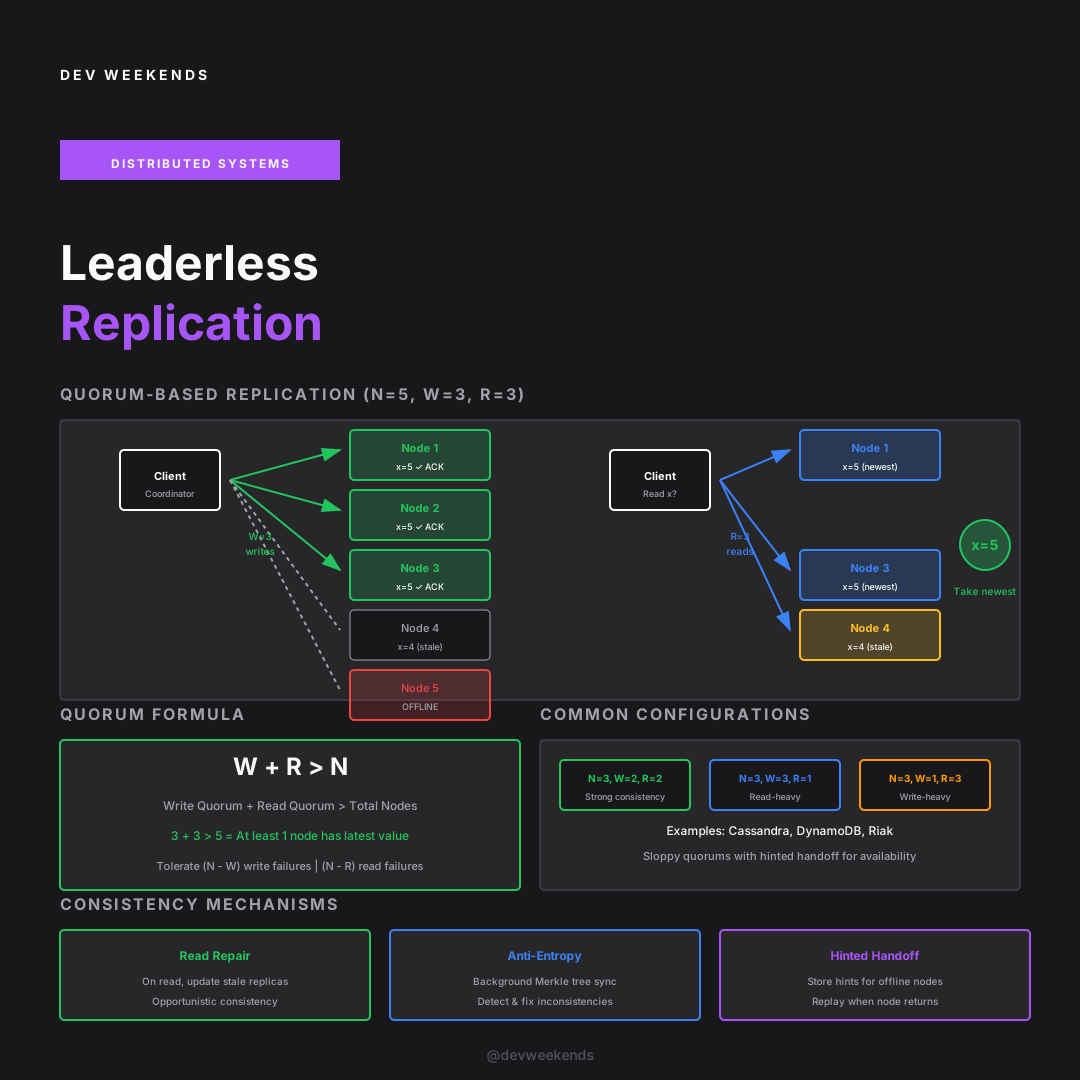 ```
┌─────────────────────────────────────────────────────────────────────────────┐
│ LEADERLESS REPLICATION │
├─────────────────────────────────────────────────────────────────────────────┤
│ │
│ NO LEADER! Client writes to multiple nodes directly. │
│ │
│ Client │
│ ┌───┐ │
│ │ │ │
│ └─┬─┘ │
│ Write │ Write │
│ ┌─────────────────┼─────────────────┐ │
│ ▼ ▼ ▼ │
│ ┌─────────┐ ┌─────────┐ ┌─────────┐ │
│ │ Node 1 │ │ Node 2 │ │ Node 3 │ │
│ │ x = 5 │ │ x = 5 │ │ x = 5 │ │
│ └─────────┘ └─────────┘ └─────────┘ │
│ │
│ QUORUMS: │
│ ──────── │
│ N = total nodes │
│ W = nodes that must acknowledge write │
│ R = nodes that must respond to read │
│ │
│ RULE: W + R > N (ensures overlap, some node has latest) │
│ │
│ COMMON CONFIGS: │
│ ─────────────── │
│ N=3, W=2, R=2: Balanced read/write, tolerates 1 failure │
│ N=3, W=3, R=1: Fast reads, writes need all nodes │
│ N=3, W=1, R=3: Fast writes, reads slower but consistent │
│ │
│ DATABASES: Cassandra, Riak, DynamoDB, Voldemort │
│ │
└─────────────────────────────────────────────────────────────────────────────┘
```
### Quorum Mathematics
```
┌─────────────────────────────────────────────────────────────────────────────┐
│ QUORUM INTERSECTION │
├─────────────────────────────────────────────────────────────────────────────┤
│ │
│ WHY W + R > N WORKS: │
│ │
│ N = 5 nodes, W = 3, R = 3 │
│ │
│ Write touches: \[1] \[2] \[3] ✓ \[ ] \[ ] │
│ Read touches: \[1] ✓ \[ ] \[4] \[5] ← Some overlap! │
│ ↑ │
│ This node has the latest write! │
│ │
│ OVERLAP = W + R - N = 3 + 3 - 5 = 1 │
│ At least 1 node in read set has latest value │
│ │
│ EDGE CASES: │
│ ─────────── │
│ W + R = N: Exactly 0 overlap possible (risky) │
│ W + R \< N: May read stale data │
│ │
├─────────────────────────────────────────────────────────────────────────────┤
│ │
│ SCENARIO: Some home nodes unreachable │
│ │
│ Client wants to write x = 5 │
│ Home nodes for x: \[A, B, C] │
│ But node C is down! │
│ │
│ STRICT QUORUM: │
│ ────────────── │
│ Wait for C or fail (reduced availability) │
│ │
│ SLOPPY QUORUM: │
│ ────────────── │
│ Write to D instead of C (D is not home node) │
│ Still get W nodes, just not the "right" ones │
│ │
│ Write: \[A ✓] \[B ✓] \[C ✗] \[D ✓ hint] │
│ │
│ HINTED HANDOFF: │
│ ─────────────── │
│ When C comes back online: │
│ D says "I have a hint for you" → sends x = 5 to C │
│ D deletes hint after C acknowledges │
│ │
│ ┌────────────────────────────────────────────────────────────────┐ │
│ │ WARNING: With sloppy quorums, W + R > N doesn't guarantee │ │
│ │ reading latest value! Reads might miss the hint node. │ │
│ └────────────────────────────────────────────────────────────────┘ │
│ │
└─────────────────────────────────────────────────────────────────────────────┘
```
### Quorum Intersection Explained

**Why This Works**: The Pigeonhole Principle
If you have N boxes and you put W + R items in them, and W + R > N, then at least one box must contain more than one item. That box represents a node that participated in both the write and the read, guaranteeing you see the latest value.
**Tuning Quorums for Your Workload**:
| Use Case | N | W | R | Rationale |
|----------|---|---|---|-----------|
| Read-heavy | 3 | 2 | 1 | Fast reads, writes need majority |
| Write-heavy | 3 | 1 | 3 | Fast writes, reads check all |
| Balanced | 3 | 2 | 2 | Equal read/write performance |
| High availability | 5 | 3 | 3 | Tolerates 2 failures |
**Latency Impact**:
- Write latency = slowest of W nodes
- Read latency = slowest of R nodes
- Lower W or R = better latency, weaker consistency
### Anti-Entropy: Read Repair and Merkle Trees
```
┌─────────────────────────────────────────────────────────────────────────────┐
│ ANTI-ENTROPY │
├─────────────────────────────────────────────────────────────────────────────┤
│ │
│ Mechanisms to detect and repair inconsistencies │
│ │
│ 1. READ REPAIR │
│ ─────────────── │
│ During reads, detect stale replicas and update them │
│ │
│ Client reads x from \[A, B, C]: │
│ A: x = 5 (version 3) │
│ B: x = 5 (version 3) │
│ C: x = 3 (version 2) ← Stale! │
│ │
│ Action: Send x = 5 to C (background repair) │
│ │
│ 2. MERKLE TREES │
│ ──────────────── │
│ Efficiently compare data between nodes │
│ │
│ ROOT (hash of children) │
│ / \ │
│ HASH(A,B) HASH(C,D) │
│ / \ / \ │
│ HASH(A) HASH(B) HASH(C) HASH(D) │
│ │ │ │ │ │
│ \[Data A] \[Data B] \[Data C] \[Data D] │
│ │
│ COMPARISON: │
│ ─────────── │
│ Node1 and Node2 exchange root hashes │
│ If same → all data matches (done!) │
│ If different → compare children, recursively find mismatches │
│ │
│ EFFICIENCY: O(log n) comparisons to find one mismatch │
│ │
└─────────────────────────────────────────────────────────────────────────────┘
````
---
## Module 14: Conflict Resolution
When conflicts happen, how do you resolve them?
### Version Vectors
```text
┌─────────────────────────────────────────────────────────────────────────────┐
│ VERSION VECTORS │
├─────────────────────────────────────────────────────────────────────────────┤
│ │
│ Like vector clocks, but for replicas instead of processes │
│ │
│ FORMAT: {replica_id: version_number, ...} │
│ │
│ EXAMPLE: │
│ ──────── │
│ Object x starts at version {A:0, B:0, C:0} │
│ │
│ Write at A: x = 5, version = {A:1, B:0, C:0} │
│ Write at B: x = 7, version = {A:0, B:1, C:0} │
│ │
│ Neither dominates the other → CONFLICT │
│ │
│ COMPARISON: │
│ ─────────── │
│ {A:1, B:0} dominates {A:0, B:0} (A:1 > A:0, B:0 = B:0) │
│ {A:1, B:0} || {A:0, B:1} (concurrent - neither dominates) │
│ │
│ SIBLING RESOLUTION: │
│ ─────────────────── │
│ 1. Present both values to application │
│ 2. Application merges and writes back │
│ 3. New version dominates both siblings │
│ │
│ x = merge(5, 7), version = {A:1, B:1, C:0} │
│ │
└─────────────────────────────────────────────────────────────────────────────┘
````
### Dotted Version Vectors (DVV)
Traditional Version Vectors can grow linearly with the number of nodes ($O(N)$ overhead) and can be imprecise for concurrent updates to the same node. **Dotted Version Vectors** (DVV), used in Riak, solve this by separating the "dot" (a specific update) from the "causal context."
**Key Benefit**: DVVs accurately distinguish between "I have seen this update" and "This update is a sibling of that one," leading to significantly fewer false conflicts during churn.
```text theme={null}
Format: [ (NodeID, Counter), VersionVector ]
- (NodeID, Counter) is the "Dot" representing the specific event.
- VersionVector is the "Context" representing what this node had seen.
```
***
### Last-Write-Wins (LWW) Deep Dive
```
┌─────────────────────────────────────────────────────────────────────────────┐
│ LAST-WRITE-WINS │
├─────────────────────────────────────────────────────────────────────────────┤
│ │
│ SIMPLE RULE: Attach timestamp, highest timestamp wins │
│ │
│ Write 1: x = 5, timestamp = 1000 │
│ Write 2: x = 7, timestamp = 1001 │
│ │
│ Winner: x = 7 │
│ │
│ PROBLEMS: │
│ ───────── │
│ │
│ 1. CLOCK SKEW │
│ Node A: 10:00:00 │
│ Node B: 10:00:01 (1 second ahead) │
│ │
│ Even if A's write was "actually" first, │
│ B's write wins because higher timestamp │
│ │
│ 2. DATA LOSS │
│ User 1: Set name = "Alice" │
│ User 2: Set email = "alice@x.com" │
│ │
│ If applied to entire object, one change is lost! │
│ Better: Apply LWW per-field │
│ │
│ 3. DELETE + UPDATE RACE │
│ User 1: Delete item │
│ User 2: Update item │
│ │
│ Which wins? Often delete loses → item reappears │
│ Use tombstones with timestamps │
│ │
│ WHEN LWW IS OK: │
│ ─────────────── │
│ • Immutable data (UUIDs as keys) │
│ • Caching (stale data acceptable) │
│ • Metrics (approximate is fine) │
│ │
└─────────────────────────────────────────────────────────────────────────────┘
```
### Application-Level Resolution
```python theme={null}
# Example: Shopping cart conflict resolution
def resolve_cart_conflict(cart1, cart2):
"""
Resolution strategy: UNION of items
cart1 = {A: 2, B: 1} (2 of A, 1 of B)
cart2 = {A: 1, C: 3} (1 of A, 3 of C)
Result: {A: 2, B: 1, C: 3}
- Take max quantity for each item
- Include items from both carts
"""
resolved = {}
all_items = set(cart1.keys()) | set(cart2.keys())
for item in all_items:
qty1 = cart1.get(item, 0)
qty2 = cart2.get(item, 0)
resolved[item] = max(qty1, qty2)
return resolved
# Example: Counter conflict resolution
def resolve_counter_conflict(counter1, counter2, base):
"""
Resolution strategy: Add deltas
base = 100
counter1 = 105 (added 5)
counter2 = 103 (added 3)
Result: 108 (100 + 5 + 3)
"""
delta1 = counter1 - base
delta2 = counter2 - base
return base + delta1 + delta2
```
***
## Module 15: CRDTs
Conflict-free Replicated Data Types - data structures that automatically merge.
**Advanced Topic**: CRDTs are asked at Staff+ level interviews, especially at companies building collaborative tools.
```
┌─────────────────────────────────────────────────────────────────────────────┐
│ CRDTs │
├─────────────────────────────────────────────────────────────────────────────┤
│ │
│ CRDT = Data structure designed to be replicated across nodes │
│ and always converge to same state without coordination │
│ │
│ KEY PROPERTY: Merge operation is: │
│ • Commutative: merge(A, B) = merge(B, A) │
│ • Associative: merge(merge(A, B), C) = merge(A, merge(B, C)) │
│ • Idempotent: merge(A, A) = A │
│ │
│ TWO TYPES: │
│ ────────── │
│ 1. State-based (CvRDT): Merge entire states │
│ 2. Operation-based (CmRDT): Replicate and apply operations │
│ │
│ TRADEOFF: │
│ ───────── │
│ State-based: Larger messages, simpler delivery │
│ Op-based: Smaller messages, require exactly-once delivery │
│ │
└─────────────────────────────────────────────────────────────────────────────┘
```
### Counter CRDTs
```
G-Counter: Only increments
STATE: {node_id: count, ...}
EXAMPLE:
────────
Node A increments: {A: 5, B: 0, C: 0}
Node B increments: {A: 0, B: 3, C: 0}
Node C increments: {A: 0, B: 0, C: 7}
MERGE: Element-wise max
{A: 5, B: 3, C: 7}
VALUE: Sum of all counts = 15
Implementation:
───────────────
class GCounter:
def __init__(self, node_id):
self.node_id = node_id
self.counts = defaultdict(int)
def increment(self, n=1):
self.counts[self.node_id] += n
def value(self):
return sum(self.counts.values())
def merge(self, other):
for node_id, count in other.counts.items():
self.counts[node_id] = max(
self.counts[node_id], count
)
```
```
PN-Counter: Increment and decrement
STATE: Two G-Counters
- P (positive): increments
- N (negative): decrements
VALUE = P.value() - N.value()
EXAMPLE:
────────
Node A: increment(5) → P = {A:5}, N = {A:0}
Node A: decrement(2) → P = {A:5}, N = {A:2}
Node B: increment(3) → P = {B:3}, N = {B:0}
Merged:
P = {A:5, B:3} = 8
N = {A:2, B:0} = 2
Value = 8 - 2 = 6
class PNCounter:
def __init__(self, node_id):
self.p = GCounter(node_id)
self.n = GCounter(node_id)
def increment(self, n=1):
self.p.increment(n)
def decrement(self, n=1):
self.n.increment(n)
def value(self):
return self.p.value() - self.n.value()
def merge(self, other):
self.p.merge(other.p)
self.n.merge(other.n)
```
### CRDT Counter Visualization
```
┌─────────────────────────────────────────────────────────────────────────────┐
│ LEADERLESS REPLICATION │
├─────────────────────────────────────────────────────────────────────────────┤
│ │
│ NO LEADER! Client writes to multiple nodes directly. │
│ │
│ Client │
│ ┌───┐ │
│ │ │ │
│ └─┬─┘ │
│ Write │ Write │
│ ┌─────────────────┼─────────────────┐ │
│ ▼ ▼ ▼ │
│ ┌─────────┐ ┌─────────┐ ┌─────────┐ │
│ │ Node 1 │ │ Node 2 │ │ Node 3 │ │
│ │ x = 5 │ │ x = 5 │ │ x = 5 │ │
│ └─────────┘ └─────────┘ └─────────┘ │
│ │
│ QUORUMS: │
│ ──────── │
│ N = total nodes │
│ W = nodes that must acknowledge write │
│ R = nodes that must respond to read │
│ │
│ RULE: W + R > N (ensures overlap, some node has latest) │
│ │
│ COMMON CONFIGS: │
│ ─────────────── │
│ N=3, W=2, R=2: Balanced read/write, tolerates 1 failure │
│ N=3, W=3, R=1: Fast reads, writes need all nodes │
│ N=3, W=1, R=3: Fast writes, reads slower but consistent │
│ │
│ DATABASES: Cassandra, Riak, DynamoDB, Voldemort │
│ │
└─────────────────────────────────────────────────────────────────────────────┘
```
### Quorum Mathematics
```
┌─────────────────────────────────────────────────────────────────────────────┐
│ QUORUM INTERSECTION │
├─────────────────────────────────────────────────────────────────────────────┤
│ │
│ WHY W + R > N WORKS: │
│ │
│ N = 5 nodes, W = 3, R = 3 │
│ │
│ Write touches: \[1] \[2] \[3] ✓ \[ ] \[ ] │
│ Read touches: \[1] ✓ \[ ] \[4] \[5] ← Some overlap! │
│ ↑ │
│ This node has the latest write! │
│ │
│ OVERLAP = W + R - N = 3 + 3 - 5 = 1 │
│ At least 1 node in read set has latest value │
│ │
│ EDGE CASES: │
│ ─────────── │
│ W + R = N: Exactly 0 overlap possible (risky) │
│ W + R \< N: May read stale data │
│ │
├─────────────────────────────────────────────────────────────────────────────┤
│ │
│ SCENARIO: Some home nodes unreachable │
│ │
│ Client wants to write x = 5 │
│ Home nodes for x: \[A, B, C] │
│ But node C is down! │
│ │
│ STRICT QUORUM: │
│ ────────────── │
│ Wait for C or fail (reduced availability) │
│ │
│ SLOPPY QUORUM: │
│ ────────────── │
│ Write to D instead of C (D is not home node) │
│ Still get W nodes, just not the "right" ones │
│ │
│ Write: \[A ✓] \[B ✓] \[C ✗] \[D ✓ hint] │
│ │
│ HINTED HANDOFF: │
│ ─────────────── │
│ When C comes back online: │
│ D says "I have a hint for you" → sends x = 5 to C │
│ D deletes hint after C acknowledges │
│ │
│ ┌────────────────────────────────────────────────────────────────┐ │
│ │ WARNING: With sloppy quorums, W + R > N doesn't guarantee │ │
│ │ reading latest value! Reads might miss the hint node. │ │
│ └────────────────────────────────────────────────────────────────┘ │
│ │
└─────────────────────────────────────────────────────────────────────────────┘
```
### Quorum Intersection Explained

**Why This Works**: The Pigeonhole Principle
If you have N boxes and you put W + R items in them, and W + R > N, then at least one box must contain more than one item. That box represents a node that participated in both the write and the read, guaranteeing you see the latest value.
**Tuning Quorums for Your Workload**:
| Use Case | N | W | R | Rationale |
|----------|---|---|---|-----------|
| Read-heavy | 3 | 2 | 1 | Fast reads, writes need majority |
| Write-heavy | 3 | 1 | 3 | Fast writes, reads check all |
| Balanced | 3 | 2 | 2 | Equal read/write performance |
| High availability | 5 | 3 | 3 | Tolerates 2 failures |
**Latency Impact**:
- Write latency = slowest of W nodes
- Read latency = slowest of R nodes
- Lower W or R = better latency, weaker consistency
### Anti-Entropy: Read Repair and Merkle Trees
```
┌─────────────────────────────────────────────────────────────────────────────┐
│ ANTI-ENTROPY │
├─────────────────────────────────────────────────────────────────────────────┤
│ │
│ Mechanisms to detect and repair inconsistencies │
│ │
│ 1. READ REPAIR │
│ ─────────────── │
│ During reads, detect stale replicas and update them │
│ │
│ Client reads x from \[A, B, C]: │
│ A: x = 5 (version 3) │
│ B: x = 5 (version 3) │
│ C: x = 3 (version 2) ← Stale! │
│ │
│ Action: Send x = 5 to C (background repair) │
│ │
│ 2. MERKLE TREES │
│ ──────────────── │
│ Efficiently compare data between nodes │
│ │
│ ROOT (hash of children) │
│ / \ │
│ HASH(A,B) HASH(C,D) │
│ / \ / \ │
│ HASH(A) HASH(B) HASH(C) HASH(D) │
│ │ │ │ │ │
│ \[Data A] \[Data B] \[Data C] \[Data D] │
│ │
│ COMPARISON: │
│ ─────────── │
│ Node1 and Node2 exchange root hashes │
│ If same → all data matches (done!) │
│ If different → compare children, recursively find mismatches │
│ │
│ EFFICIENCY: O(log n) comparisons to find one mismatch │
│ │
└─────────────────────────────────────────────────────────────────────────────┘
````
---
## Module 14: Conflict Resolution
When conflicts happen, how do you resolve them?
### Version Vectors
```text
┌─────────────────────────────────────────────────────────────────────────────┐
│ VERSION VECTORS │
├─────────────────────────────────────────────────────────────────────────────┤
│ │
│ Like vector clocks, but for replicas instead of processes │
│ │
│ FORMAT: {replica_id: version_number, ...} │
│ │
│ EXAMPLE: │
│ ──────── │
│ Object x starts at version {A:0, B:0, C:0} │
│ │
│ Write at A: x = 5, version = {A:1, B:0, C:0} │
│ Write at B: x = 7, version = {A:0, B:1, C:0} │
│ │
│ Neither dominates the other → CONFLICT │
│ │
│ COMPARISON: │
│ ─────────── │
│ {A:1, B:0} dominates {A:0, B:0} (A:1 > A:0, B:0 = B:0) │
│ {A:1, B:0} || {A:0, B:1} (concurrent - neither dominates) │
│ │
│ SIBLING RESOLUTION: │
│ ─────────────────── │
│ 1. Present both values to application │
│ 2. Application merges and writes back │
│ 3. New version dominates both siblings │
│ │
│ x = merge(5, 7), version = {A:1, B:1, C:0} │
│ │
└─────────────────────────────────────────────────────────────────────────────┘
````
### Dotted Version Vectors (DVV)
Traditional Version Vectors can grow linearly with the number of nodes ($O(N)$ overhead) and can be imprecise for concurrent updates to the same node. **Dotted Version Vectors** (DVV), used in Riak, solve this by separating the "dot" (a specific update) from the "causal context."
**Key Benefit**: DVVs accurately distinguish between "I have seen this update" and "This update is a sibling of that one," leading to significantly fewer false conflicts during churn.
```text theme={null}
Format: [ (NodeID, Counter), VersionVector ]
- (NodeID, Counter) is the "Dot" representing the specific event.
- VersionVector is the "Context" representing what this node had seen.
```
***
### Last-Write-Wins (LWW) Deep Dive
```
┌─────────────────────────────────────────────────────────────────────────────┐
│ LAST-WRITE-WINS │
├─────────────────────────────────────────────────────────────────────────────┤
│ │
│ SIMPLE RULE: Attach timestamp, highest timestamp wins │
│ │
│ Write 1: x = 5, timestamp = 1000 │
│ Write 2: x = 7, timestamp = 1001 │
│ │
│ Winner: x = 7 │
│ │
│ PROBLEMS: │
│ ───────── │
│ │
│ 1. CLOCK SKEW │
│ Node A: 10:00:00 │
│ Node B: 10:00:01 (1 second ahead) │
│ │
│ Even if A's write was "actually" first, │
│ B's write wins because higher timestamp │
│ │
│ 2. DATA LOSS │
│ User 1: Set name = "Alice" │
│ User 2: Set email = "alice@x.com" │
│ │
│ If applied to entire object, one change is lost! │
│ Better: Apply LWW per-field │
│ │
│ 3. DELETE + UPDATE RACE │
│ User 1: Delete item │
│ User 2: Update item │
│ │
│ Which wins? Often delete loses → item reappears │
│ Use tombstones with timestamps │
│ │
│ WHEN LWW IS OK: │
│ ─────────────── │
│ • Immutable data (UUIDs as keys) │
│ • Caching (stale data acceptable) │
│ • Metrics (approximate is fine) │
│ │
└─────────────────────────────────────────────────────────────────────────────┘
```
### Application-Level Resolution
```python theme={null}
# Example: Shopping cart conflict resolution
def resolve_cart_conflict(cart1, cart2):
"""
Resolution strategy: UNION of items
cart1 = {A: 2, B: 1} (2 of A, 1 of B)
cart2 = {A: 1, C: 3} (1 of A, 3 of C)
Result: {A: 2, B: 1, C: 3}
- Take max quantity for each item
- Include items from both carts
"""
resolved = {}
all_items = set(cart1.keys()) | set(cart2.keys())
for item in all_items:
qty1 = cart1.get(item, 0)
qty2 = cart2.get(item, 0)
resolved[item] = max(qty1, qty2)
return resolved
# Example: Counter conflict resolution
def resolve_counter_conflict(counter1, counter2, base):
"""
Resolution strategy: Add deltas
base = 100
counter1 = 105 (added 5)
counter2 = 103 (added 3)
Result: 108 (100 + 5 + 3)
"""
delta1 = counter1 - base
delta2 = counter2 - base
return base + delta1 + delta2
```
***
## Module 15: CRDTs
Conflict-free Replicated Data Types - data structures that automatically merge.
**Advanced Topic**: CRDTs are asked at Staff+ level interviews, especially at companies building collaborative tools.
```
┌─────────────────────────────────────────────────────────────────────────────┐
│ CRDTs │
├─────────────────────────────────────────────────────────────────────────────┤
│ │
│ CRDT = Data structure designed to be replicated across nodes │
│ and always converge to same state without coordination │
│ │
│ KEY PROPERTY: Merge operation is: │
│ • Commutative: merge(A, B) = merge(B, A) │
│ • Associative: merge(merge(A, B), C) = merge(A, merge(B, C)) │
│ • Idempotent: merge(A, A) = A │
│ │
│ TWO TYPES: │
│ ────────── │
│ 1. State-based (CvRDT): Merge entire states │
│ 2. Operation-based (CmRDT): Replicate and apply operations │
│ │
│ TRADEOFF: │
│ ───────── │
│ State-based: Larger messages, simpler delivery │
│ Op-based: Smaller messages, require exactly-once delivery │
│ │
└─────────────────────────────────────────────────────────────────────────────┘
```
### Counter CRDTs
```
G-Counter: Only increments
STATE: {node_id: count, ...}
EXAMPLE:
────────
Node A increments: {A: 5, B: 0, C: 0}
Node B increments: {A: 0, B: 3, C: 0}
Node C increments: {A: 0, B: 0, C: 7}
MERGE: Element-wise max
{A: 5, B: 3, C: 7}
VALUE: Sum of all counts = 15
Implementation:
───────────────
class GCounter:
def __init__(self, node_id):
self.node_id = node_id
self.counts = defaultdict(int)
def increment(self, n=1):
self.counts[self.node_id] += n
def value(self):
return sum(self.counts.values())
def merge(self, other):
for node_id, count in other.counts.items():
self.counts[node_id] = max(
self.counts[node_id], count
)
```
```
PN-Counter: Increment and decrement
STATE: Two G-Counters
- P (positive): increments
- N (negative): decrements
VALUE = P.value() - N.value()
EXAMPLE:
────────
Node A: increment(5) → P = {A:5}, N = {A:0}
Node A: decrement(2) → P = {A:5}, N = {A:2}
Node B: increment(3) → P = {B:3}, N = {B:0}
Merged:
P = {A:5, B:3} = 8
N = {A:2, B:0} = 2
Value = 8 - 2 = 6
class PNCounter:
def __init__(self, node_id):
self.p = GCounter(node_id)
self.n = GCounter(node_id)
def increment(self, n=1):
self.p.increment(n)
def decrement(self, n=1):
self.n.increment(n)
def value(self):
return self.p.value() - self.n.value()
def merge(self, other):
self.p.merge(other.p)
self.n.merge(other.n)
```
### CRDT Counter Visualization
 **Why CRDTs Are Powerful**:
Traditional approach:
```
Node A: counter = 5
Node B: counter = 3
Merge: ??? (conflict!)
```
CRDT approach:
```
Node A: {A: 5, B: 0, C: 0}
Node B: {A: 0, B: 3, C: 0}
Merge: {A: 5, B: 3, C: 0} → value = 8 (no conflict!)
```
**Real-World CRDT Usage**:
* **Redis**: CRDT-based geo-replicated databases
* **Riak**: Uses CRDTs for distributed counters and sets
* **Figma**: Uses CRDTs for collaborative design
* **Apple Notes**: CRDTs for offline-first sync
**Tradeoff**: CRDTs require more memory (store per-node state) but eliminate coordination overhead.
### Set CRDTs
```
G-Set: Only adds, never removes
STATE: Set of elements
MERGE: Union of sets
Node A: {apple, banana}
Node B: {banana, cherry}
Merge: {apple, banana, cherry}
class GSet:
def __init__(self):
self.elements = set()
def add(self, element):
self.elements.add(element)
def contains(self, element):
return element in self.elements
def merge(self, other):
self.elements |= other.elements
```
```
2P-Set: Add and remove (but can't re-add after remove)
STATE: Two G-Sets
- A (added): elements added
- R (removed): elements removed (tombstones)
CONTAINS: element in A and not in R
LIMITATION: Once removed, can never add again
class TwoPSet:
def __init__(self):
self.a = GSet() # added
self.r = GSet() # removed
def add(self, element):
self.a.add(element)
def remove(self, element):
if element in self.a.elements:
self.r.add(element)
def contains(self, element):
return (element in self.a.elements and
element not in self.r.elements)
def merge(self, other):
self.a.merge(other.a)
self.r.merge(other.r)
```
```
OR-Set: Add and remove with re-add support
IDEA: Tag each addition with unique ID
Remove only removes specific tag, not all
STATE: {element: set of (tag, is_added)}
EXAMPLE:
────────
Add "apple" at A: {apple: {(uuid1, true)}}
Add "apple" at B: {apple: {(uuid2, true)}}
Remove "apple" at A: {apple: {(uuid1, false), (uuid2, true)}}
Contains: At least one (tag, true) without matching (tag, false)
"apple" is still in set because uuid2 wasn't removed!
USED BY:
• Riak
• Redis Enterprise (Active-Active)
• SoundCloud's Roshi
```
### Register CRDTs
```
┌─────────────────────────────────────────────────────────────────────────────┐
│ REGISTER CRDTs │
├─────────────────────────────────────────────────────────────────────────────┤
│ │
│ LWW-REGISTER (Last-Write-Wins) │
│ ────────────────────────────── │
│ STATE: (value, timestamp) │
│ MERGE: Keep higher timestamp │
│ │
│ A: ("Alice", 100) │
│ B: ("Bob", 101) │
│ Merge: ("Bob", 101) │
│ │
│ MV-REGISTER (Multi-Value) │
│ ───────────────────────── │
│ STATE: Set of (value, version-vector) │
│ MERGE: Keep all concurrent values │
│ │
│ A: ("Alice", {A:1}) │
│ B: ("Bob", {B:1}) │
│ Merge: {("Alice", {A:1}), ("Bob", {B:1})} ← Both kept as siblings │
│ │
│ Application must resolve by writing new value: │
│ Write: ("Alice or Bob", {A:1, B:1}) │
│ │
└─────────────────────────────────────────────────────────────────────────────┘
```
### JSON CRDTs & Rich Text (Automerge/Yjs)
Modeling a simple counter or set is one thing, but how do you model a **JSON Document** or a **Rich Text Document** (like this one)?
#### 1. JSON CRDT Architecture
A JSON CRDT models the document as a **Tree of CRDTs**.
* **Objects**: Maps where keys map to other CRDTs.
* **Arrays**: Sequences where each element has a unique ID and a pointer to the previous element (**RGA - Replicated Growable Array**).
* **Registers**: For leaf values (strings, numbers).
#### 2. The Interleaving Problem
In collaborative text editing, if Alice inserts "A" and Bob inserts "B" at the same position, a naive CRDT might result in "BA" for Alice and "AB" for Bob. Modern CRDTs like **Yjs** and **Automerge** use **Causal Ordering** and **Unique IDs** to ensure that all replicas agree on the order (e.g., "AB" for everyone).
***
### Delta-CRDTs: Optimizing Bandwidth
The biggest drawback of **State-based CRDTs (CvRDTs)** is that the state grows over time. If you have a counter with 1,000 nodes, you must send all 1,000 counts every time you sync.
**Delta-CRDTs** solve this by only sending the **Delta** (the changes) since the last successful synchronization.
* **Dot Store**: A way to track which specific updates (dots) a neighbor has already seen.
* **Delta-Group**: A collection of updates that are merged together before being sent.
* **Efficiency**: Reduces bandwidth from $O(N)$ to $O(\Delta)$, making CRDTs viable for mobile devices on slow networks.
***
### Garbage Collection & Tombstones
When you remove an element from a CRDT (like a `2P-Set` or `OR-Set`), you must keep a **Tombstone** to prove to other nodes that the item was deleted. If you delete the tombstone too early, a node that hasn't seen the deletion might "re-infect" the cluster with the old data.
#### Strategies for Cleaning Tombstones:
1. **Stable State GC**: Only delete a tombstone once you have proof (via gossip) that **every node in the cluster** has seen the deletion.
2. **Time-based GC**: Delete tombstones after a very long period (e.g., 30 days). If a node stays offline longer than that, it must be completely wiped and re-synced from scratch.
***
### CRDT Usage in Practice
```
PRODUCTION CRDT SYSTEMS:
────────────────────────
┌──────────────────┬───────────────────────────────────────────────┐
│ System │ CRDT Usage │
├──────────────────┼───────────────────────────────────────────────┤
│ Riak │ Counters, Sets, Maps, Registers │
│ Redis Enterprise │ Counters, Sets for Active-Active │
│ Phoenix (Elixir) │ Presence tracking with ORSets │
│ Apple (Notes) │ CRDT-based sync │
│ Figma │ Custom CRDTs for collaborative design │
│ SoundCloud │ Roshi (LWW-Set for activity feeds) │
│ League of Legends│ Player state sync │
└──────────────────┴───────────────────────────────────────────────┘
LIMITATIONS:
────────────
• Memory overhead (tombstones, version vectors)
• Not suitable for all data types
• Complex to implement correctly
• May need garbage collection for tombstones
```
### Multi-Paxos / Raft Groups (Sharded Consensus)
A single consensus group (e.g., one Raft cluster) is bottlenecked by the CPU and I/O of a single leader. To scale to millions of requests, you must use **Sharded Consensus**.
#### Architecture: Multi-Group
Instead of one large group, we partition the data into many small shards, each managed by its own independent consensus group.
```text theme={null}
┌───────────────────────────────────────────────────────────────┐
│ SHARDED CONSENSUS GROUPS │
├───────────────────────────────────────────────────────────────┤
│ │
│ SHARD A (Keys 0-99) SHARD B (Keys 100-199) │
│ ┌─────────────────┐ ┌─────────────────┐ │
│ │ Raft Group 1 │ │ Raft Group 2 │ │
│ │ (Nodes 1, 2, 3) │ │ (Nodes 4, 5, 6) │ │
│ └─────────────────┘ └─────────────────┘ │
│ │
│ COORDINATOR: A "Placement Driver" or "Master" tracks which │
│ nodes belong to which Raft groups. │
│ │
└───────────────────────────────────────────────────────────────┘
```
#### The Challenge: Cross-Shard Transactions
When an operation affects multiple shards (e.g., `Transfer($5) from Shard A to Shard B`), you need a higher-level protocol like **Two-Phase Commit (2PC)** or **Percolator** to coordinate across the individual consensus groups.
**Used By**: CockroachDB (Ranges), TiDB (Regions), and Google Spanner (Paxos Groups).
***
### Chain Replication
Chain replication is a widely used technique for high-throughput, linearizable replication. It is used in systems like FAWN and CORFU.
```
┌─────────────────────────────────────────────────────────────────────────────┐
│ CHAIN REPLICATION │
├─────────────────────────────────────────────────────────────────────────────┤
│ │
│ STRUCTURE: Nodes are arranged in a chain: Head → ... → Tail │
│ │
│ WRITE PATH: │
│ 1. Client sends write to the HEAD. │
│ 2. Head applies write and forwards to next node. │
│ 3. Propagation continues until it reaches the TAIL. │
│ 4. Tail sends ACK back up the chain or directly to client. │
│ │
│ READ PATH: │
│ 1. Clients read ONLY from the TAIL. │
│ │
│ WHY IT WORKS: │
│ - Linearizability: A write is only visible (at the Tail) once it has been │
│ persisted by ALL nodes in the chain. │
│ - Higher Throughput: The load is distributed across the chain. │
│ │
│ FAILURE HANDLING: │
│ - Head fails: Next node becomes the new Head. │
│ - Tail fails: Predecessor becomes the new Tail. │
│ - Internal node fails: Predecessor and successor link up. │
│ │
└─────────────────────────────────────────────────────────────────────────────┘
```
***
## Advanced Design Scenarios
### Scenario 1: Global E‑Commerce Database Replication
You run a global e‑commerce platform with users in US, EU, and APAC. You want **strong guarantees for orders and payments**, but can tolerate slightly stale reads for product browsing.
**Design**:
* **Topology**:
* Single **write leader region** (e.g., `us-east-1`) with synchronous followers in the same region.
* **Read replicas per region** (EU, APAC) receiving asynchronous replication from the leader.
* **Write path**:
* All order and payment writes go to the **regional leader** in `us-east-1`.
* Use **semi-synchronous replication** inside the leader region: commit after 1 follower ACK to avoid single-copy-of-truth.
* **Read path**:
* **Critical reads** (order status, payment status): hit the leader region or only replicas with **replication lag \< T ms**.
* **Non-critical reads** (product catalog, reviews): go to nearest regional replica even if seconds behind.
```text theme={null}
US-East (Primary Region)
- primary-db (leader, sync to 1 follower)
- follower-db-1 (sync)
- follower-db-2 (async)
EU-West (Read Region)
- repl-db-eu (async follower)
AP-South (Read Region)
- repl-db-ap (async follower)
```
**Consistency & failure behavior**:
* **RPO/RTO**:
* With semi-sync in primary region, losing the leader does **not** lose committed transactions; failover to the in-region sync follower.
* Cross-region replication remains **async** → if the entire region fails, you may lose up to (Δ) seconds of writes that haven’t replicated.
* **Patterns used**:
* From this module: **single-leader replication**, **sync vs async**, **replication lag awareness**, and **failover**.
* Combined with consistency models: guarantee **read-your-writes** by routing post-write reads to the leader or using a `min_lsn`/`min_commit_time` threshold on replicas.
***
### Scenario 2: Active‑Active User Profile Store
You want low-latency profile updates and reads from any region, and you’re willing to accept **eventual consistency** for some fields but not for others.
**Requirements**:
* Profile updates can happen in **any region** (multi-leader / active‑active).
* Some fields (e.g., `email`, `phone`) must avoid conflicting values.
* Other fields (e.g., `last_seen_at`, `recently_viewed`) can be merged.
**Design**:
* **Multi-leader replication** between regions with a log for each leader.
* **Per-field conflict resolution strategy**:
* Identity fields (`email`, `phone`, `name`): **Last-Write-Wins per field** with server-side timestamps (avoid whole-record LWW).
* Activity fields (`recently_viewed`, `devices`, `tags`): treat as **CRDT sets or counters** and **merge**.
```text theme={null}
Profile document:
{
id: "user-123",
email: { value: "a@x.com", ts: 1700000000 },
phone: { value: "+1-555-...", ts: 1700000100 },
devices: G-Set of device IDs,
tags: OR-Set of tags
}
On update:
- For scalar fields: compare timestamps.
- For sets: CRDT merge (union / OR‑Set semantics).
```
**Failure / partition behavior**:
* During a partition, each region continues accepting writes.
* On healing:
* For scalars, keep value with **newer timestamp** (assuming bounded skew, or use hybrid logical clocks).
* For sets/counters, apply CRDT **merge** (no conflicts).
This scenario composes:
* **Multi-leader replication** + **conflict detection** (version vectors or timestamps).
* **Conflict resolution** strategies and **CRDTs** for different fields in the same entity.
***
### Scenario 3: Leaderless Metrics Store with Tunable Consistency
You’re designing a high-throughput **metrics and logs** store similar to Dynamo/Cassandra. Availability and write throughput matter more than strict consistency.
**Design**:
* **Leaderless replication** with parameters (N, W, R):
* (N = 3) replicas per key.
* For **writes**: (W = 2) for production metrics, (W = 1) for debug logs.
* For **reads**: (R = 1) for dashboards where staleness is acceptable, (R = 2) for alerting queries.
* **Anti-entropy**:
* Enable **read repair** on reads (update stale replicas in background).
* Periodically run **Merkle tree** comparisons between nodes to reconcile drift.
```text theme={null}
Write metrics(point):
- Hash(key) → choose N replicas.
- Try to write to all N.
- If at least W ACKs within timeout → success.
- If fewer than W → client sees write failure (but some replicas may still store point).
Read metrics(query):
- Contact R replicas.
- Return value with latest timestamp.
- Schedule background repairs for stale replicas.
```
**Partition & failure behavior**:
* **Partial node failures**: As long as at least (W) nodes are reachable for writes and (R) for reads, the system remains available with overlapping quorums.
* **Sloppy quorums + hinted handoff**:
* When a home replica is down, temporarily write to a substitute node (hinted handoff) to keep (W) high.
* On recovery, hints are replayed to repair the downed node.
* **Trade-offs**:
* For **alerting**: configure (W + R > N) and avoid sloppy quorums to favor correctness.
* For **debug logs**: allow (W = 1, R = 1) and sloppy quorums to maximize write availability.
This scenario applies:
* **Quorum mathematics** ((W + R > N)), **sloppy quorums**, **hinted handoff**, and **anti-entropy** techniques from this module in a concrete operational design.
***
## Key Interview Questions
**Choose leaderless when**:
* High availability is critical (any node can accept writes)
* Write latency matters (write to nearest nodes)
* Can tolerate eventual consistency
* Multi-datacenter with no clear primary
**Choose leader-based when**:
* Need strong consistency
* Transactions required
* Simpler conflict resolution
* Read-heavy workload (scale reads with followers)
**Examples**:
* Leaderless: Session data, user activity, metrics
* Leader: Financial transactions, inventory, user accounts
**Requirements analysis**:
* Cart shared across devices
* Offline support
* Reasonable merge behavior
**Solution**:
```
Cart Item = (product_id, quantity, timestamps)
Add item:
- If not exists: add with current timestamp
- If exists: max(qty1, qty2), latest timestamp
Remove item:
- Use tombstone with timestamp
- Remove wins if remove_timestamp > add_timestamp
Merge strategy:
1. Union all product_ids
2. For each product:
- If removed in both → removed
- If removed in one with later timestamp → removed
- Otherwise → max(quantities)
Alternative: Use OR-Set CRDT for cart items
```
**Common scenario**: User updates profile, immediately views it, sees old data.
**Solutions**:
1. **Read-your-writes consistency**
* Track writes with client-side timestamp
* Read from replica that's caught up
* Or read from leader for recently-written data
2. **Monotonic reads**
* Stick user to same replica (session affinity)
* Or track last-seen replica position
3. **Synchronous replication for critical data**
* Higher latency but guaranteed consistency
4. **Application-level workaround**
* Optimistic UI (assume success)
* Show cached data with "syncing" indicator
**Answer**:
```
Architecture:
- Leaderless, all nodes equal
- Consistent hashing for partitioning
- Configurable replication factor (RF)
Write path:
1. Client writes to any coordinator
2. Coordinator forwards to RF replicas
3. Wait for W acknowledgments
4. Return success
Read path:
1. Coordinator contacts R replicas
2. Returns result with highest timestamp
3. Background read repair if inconsistency
Consistency levels:
- ONE: Fast, might be stale
- QUORUM: W + R > RF, usually consistent
- ALL: All replicas, strongest but slowest
- LOCAL_QUORUM: Quorum within datacenter
Anti-entropy:
- Read repair on reads
- Merkle tree comparison
- Hinted handoff when nodes down
```
***
## Next Steps
Learn 2PC, Saga pattern, and distributed locking
***
## Interview Deep-Dive
**Strong Answer:**
* Single-leader replication (Raft-backed, primary-replica) gives you strong consistency guarantees with a simple mental model: all writes go to one node, followers replicate in order. The cost is that write latency equals the round-trip to the leader. If the leader is in US-East and a user in Tokyo writes, they pay 150ms+ cross-Pacific latency. Leader failure also causes a brief unavailability window during election (typically 1-5 seconds for Raft).
* Leaderless replication (Dynamo-style: Cassandra, Riak) removes the single-leader bottleneck. Any node can accept writes, so users write to the nearest replica with low latency. Reads are consistent if R + W > N (quorum overlap guarantees at least one node in the read set has the latest value). The cost is operational complexity: you need conflict resolution strategies, you lose serializability across keys, and sloppy quorums can break consistency guarantees.
* My recommendation depends on the workload. For a service requiring strong consistency (financial ledger, authentication tokens), I choose single-leader. For a service where availability and low latency matter more (user profiles, shopping carts, IoT telemetry), I choose leaderless. For the middle ground (social feeds, collaborative tools), I consider multi-leader with conflict resolution.
**Follow-up: What is the problem with sloppy quorums and why do they break the consistency guarantee?**
A sloppy quorum allows writes to be acknowledged by nodes that are not the "home" nodes for the data -- temporary stand-ins when the actual replicas are unreachable. The quorum overlap guarantee (R + W > N) assumes reads and writes hit the same set of N nodes. With sloppy quorums, a write might go to nodes A, B, D (where D is a stand-in for the unreachable C), but a subsequent read hits A, B, C. D has the latest value but is not in the read set, so the read returns stale data. The value on D will eventually reach C via hinted handoff, but until then, the system is inconsistent. Sloppy quorums prioritize write availability over consistency.
**Strong Answer:**
* Replication lag is the delay between a write committed on the primary and that write being visible on a follower. In single-leader systems with async replication, lag ranges from milliseconds (same DC) to seconds (cross-region), and can spike to minutes under load.
* The user experience impact is the "time travel" effect: a user writes data, gets success, then reads from a follower and does not see their own write. For example, a user posts a comment, the page refreshes hitting a follower, and the comment is missing.
* Detection: instrument replication lag as a first-class metric. For MySQL, monitor Seconds\_Behind\_Master. For PostgreSQL, monitor pg\_stat\_replication.replay\_lag. Set alerts when lag exceeds your SLA.
* Mitigation: (1) Read-your-writes -- after a write, route subsequent reads from the same session to the primary or a fresh replica. (2) Monotonic reads -- pin sessions to a specific replica so users never go back in time. (3) Synchronous replication for critical paths -- writes wait for at least one follower, reducing lag at the cost of latency. (4) If using Kafka, auto-scale consumers when lag grows.
**Follow-up: What happens if replication lag grows so large that a follower falls permanently behind?**
If a follower falls behind to the point where the primary's WAL has been rotated and the follower's position is no longer available, incremental catch-up is impossible. The follower needs a full resynchronization: snapshot the primary, restore on the follower, then replay WAL from the snapshot position. During recovery, the follower is unavailable for reads. To prevent this: size WAL retention for worst-case lag, monitor the distance between follower and primary positions, and alert before WAL expires.
**Strong Answer:**
* CRDTs are data structures where concurrent updates on different replicas can always be merged automatically. The merge operation is commutative, associative, and idempotent -- updates arrive in any order, apply multiple times, and the result is always the same.
* A G-Counter is the simplest example: each replica maintains its own counter, the global count is the sum. Incrementing is local. Merging is element-wise max. A PN-Counter extends this with a separate decrement counter. An OR-Set supports add and remove by tagging each add with a unique ID.
* Limitations: (1) CRDTs can only express monotonically growing information, so operations like "set to exactly 5" require careful encoding with metadata overhead. (2) Metadata grows over time -- tombstones, per-replica counters -- and garbage collecting it requires the coordination CRDTs are designed to avoid. (3) CRDTs cannot express arbitrary invariants. A CRDT bank account cannot prevent negative balances because enforcing that constraint requires knowing global state.
**Follow-up: How does Riak handle CRDT tombstone garbage collection in practice?**
Riak uses a tombstone timeout -- after a configurable period, tombstones are eligible for garbage collection. The danger is if a replica is offline longer than the timeout, it might re-introduce a deleted item when it comes back online (tombstone resurrection). The mitigation is to set the timeout longer than maximum expected replica downtime and run anti-entropy (Merkle tree comparison) frequently enough to catch and repair inconsistencies before they reach users.
**Strong Answer:**
* With strict quorum, clients can still read and write. One node is isolated, leaving 2 reachable. W=2 is satisfied by both available nodes. R=2 is satisfied by both available nodes. The system remains operational.
* The isolated node may serve requests from clients on its side of the partition. With strict quorums, those clients cannot form a quorum (only 1 node available), so their operations fail -- this is the safe behavior.
* After the partition heals, the isolated node catches up via read repair (inconsistencies detected during reads) and anti-entropy repair (Merkle tree comparison). If neither runs promptly, the node may serve stale data.
**Follow-up: How would you detect that a Cassandra node has stale data after a partition heals?**
Run a full anti-entropy repair immediately after partition healing (nodetool repair). Monitor ReadRepairAttempted counters -- a spike after healing indicates widespread staleness. Deploy a synthetic monitoring job that writes a known value, then reads from each individual replica using CL=ONE with explicit routing and compares. If any replica returns stale data, trigger an alert. The goal is to detect staleness before real users encounter it.
**Why CRDTs Are Powerful**:
Traditional approach:
```
Node A: counter = 5
Node B: counter = 3
Merge: ??? (conflict!)
```
CRDT approach:
```
Node A: {A: 5, B: 0, C: 0}
Node B: {A: 0, B: 3, C: 0}
Merge: {A: 5, B: 3, C: 0} → value = 8 (no conflict!)
```
**Real-World CRDT Usage**:
* **Redis**: CRDT-based geo-replicated databases
* **Riak**: Uses CRDTs for distributed counters and sets
* **Figma**: Uses CRDTs for collaborative design
* **Apple Notes**: CRDTs for offline-first sync
**Tradeoff**: CRDTs require more memory (store per-node state) but eliminate coordination overhead.
### Set CRDTs
```
G-Set: Only adds, never removes
STATE: Set of elements
MERGE: Union of sets
Node A: {apple, banana}
Node B: {banana, cherry}
Merge: {apple, banana, cherry}
class GSet:
def __init__(self):
self.elements = set()
def add(self, element):
self.elements.add(element)
def contains(self, element):
return element in self.elements
def merge(self, other):
self.elements |= other.elements
```
```
2P-Set: Add and remove (but can't re-add after remove)
STATE: Two G-Sets
- A (added): elements added
- R (removed): elements removed (tombstones)
CONTAINS: element in A and not in R
LIMITATION: Once removed, can never add again
class TwoPSet:
def __init__(self):
self.a = GSet() # added
self.r = GSet() # removed
def add(self, element):
self.a.add(element)
def remove(self, element):
if element in self.a.elements:
self.r.add(element)
def contains(self, element):
return (element in self.a.elements and
element not in self.r.elements)
def merge(self, other):
self.a.merge(other.a)
self.r.merge(other.r)
```
```
OR-Set: Add and remove with re-add support
IDEA: Tag each addition with unique ID
Remove only removes specific tag, not all
STATE: {element: set of (tag, is_added)}
EXAMPLE:
────────
Add "apple" at A: {apple: {(uuid1, true)}}
Add "apple" at B: {apple: {(uuid2, true)}}
Remove "apple" at A: {apple: {(uuid1, false), (uuid2, true)}}
Contains: At least one (tag, true) without matching (tag, false)
"apple" is still in set because uuid2 wasn't removed!
USED BY:
• Riak
• Redis Enterprise (Active-Active)
• SoundCloud's Roshi
```
### Register CRDTs
```
┌─────────────────────────────────────────────────────────────────────────────┐
│ REGISTER CRDTs │
├─────────────────────────────────────────────────────────────────────────────┤
│ │
│ LWW-REGISTER (Last-Write-Wins) │
│ ────────────────────────────── │
│ STATE: (value, timestamp) │
│ MERGE: Keep higher timestamp │
│ │
│ A: ("Alice", 100) │
│ B: ("Bob", 101) │
│ Merge: ("Bob", 101) │
│ │
│ MV-REGISTER (Multi-Value) │
│ ───────────────────────── │
│ STATE: Set of (value, version-vector) │
│ MERGE: Keep all concurrent values │
│ │
│ A: ("Alice", {A:1}) │
│ B: ("Bob", {B:1}) │
│ Merge: {("Alice", {A:1}), ("Bob", {B:1})} ← Both kept as siblings │
│ │
│ Application must resolve by writing new value: │
│ Write: ("Alice or Bob", {A:1, B:1}) │
│ │
└─────────────────────────────────────────────────────────────────────────────┘
```
### JSON CRDTs & Rich Text (Automerge/Yjs)
Modeling a simple counter or set is one thing, but how do you model a **JSON Document** or a **Rich Text Document** (like this one)?
#### 1. JSON CRDT Architecture
A JSON CRDT models the document as a **Tree of CRDTs**.
* **Objects**: Maps where keys map to other CRDTs.
* **Arrays**: Sequences where each element has a unique ID and a pointer to the previous element (**RGA - Replicated Growable Array**).
* **Registers**: For leaf values (strings, numbers).
#### 2. The Interleaving Problem
In collaborative text editing, if Alice inserts "A" and Bob inserts "B" at the same position, a naive CRDT might result in "BA" for Alice and "AB" for Bob. Modern CRDTs like **Yjs** and **Automerge** use **Causal Ordering** and **Unique IDs** to ensure that all replicas agree on the order (e.g., "AB" for everyone).
***
### Delta-CRDTs: Optimizing Bandwidth
The biggest drawback of **State-based CRDTs (CvRDTs)** is that the state grows over time. If you have a counter with 1,000 nodes, you must send all 1,000 counts every time you sync.
**Delta-CRDTs** solve this by only sending the **Delta** (the changes) since the last successful synchronization.
* **Dot Store**: A way to track which specific updates (dots) a neighbor has already seen.
* **Delta-Group**: A collection of updates that are merged together before being sent.
* **Efficiency**: Reduces bandwidth from $O(N)$ to $O(\Delta)$, making CRDTs viable for mobile devices on slow networks.
***
### Garbage Collection & Tombstones
When you remove an element from a CRDT (like a `2P-Set` or `OR-Set`), you must keep a **Tombstone** to prove to other nodes that the item was deleted. If you delete the tombstone too early, a node that hasn't seen the deletion might "re-infect" the cluster with the old data.
#### Strategies for Cleaning Tombstones:
1. **Stable State GC**: Only delete a tombstone once you have proof (via gossip) that **every node in the cluster** has seen the deletion.
2. **Time-based GC**: Delete tombstones after a very long period (e.g., 30 days). If a node stays offline longer than that, it must be completely wiped and re-synced from scratch.
***
### CRDT Usage in Practice
```
PRODUCTION CRDT SYSTEMS:
────────────────────────
┌──────────────────┬───────────────────────────────────────────────┐
│ System │ CRDT Usage │
├──────────────────┼───────────────────────────────────────────────┤
│ Riak │ Counters, Sets, Maps, Registers │
│ Redis Enterprise │ Counters, Sets for Active-Active │
│ Phoenix (Elixir) │ Presence tracking with ORSets │
│ Apple (Notes) │ CRDT-based sync │
│ Figma │ Custom CRDTs for collaborative design │
│ SoundCloud │ Roshi (LWW-Set for activity feeds) │
│ League of Legends│ Player state sync │
└──────────────────┴───────────────────────────────────────────────┘
LIMITATIONS:
────────────
• Memory overhead (tombstones, version vectors)
• Not suitable for all data types
• Complex to implement correctly
• May need garbage collection for tombstones
```
### Multi-Paxos / Raft Groups (Sharded Consensus)
A single consensus group (e.g., one Raft cluster) is bottlenecked by the CPU and I/O of a single leader. To scale to millions of requests, you must use **Sharded Consensus**.
#### Architecture: Multi-Group
Instead of one large group, we partition the data into many small shards, each managed by its own independent consensus group.
```text theme={null}
┌───────────────────────────────────────────────────────────────┐
│ SHARDED CONSENSUS GROUPS │
├───────────────────────────────────────────────────────────────┤
│ │
│ SHARD A (Keys 0-99) SHARD B (Keys 100-199) │
│ ┌─────────────────┐ ┌─────────────────┐ │
│ │ Raft Group 1 │ │ Raft Group 2 │ │
│ │ (Nodes 1, 2, 3) │ │ (Nodes 4, 5, 6) │ │
│ └─────────────────┘ └─────────────────┘ │
│ │
│ COORDINATOR: A "Placement Driver" or "Master" tracks which │
│ nodes belong to which Raft groups. │
│ │
└───────────────────────────────────────────────────────────────┘
```
#### The Challenge: Cross-Shard Transactions
When an operation affects multiple shards (e.g., `Transfer($5) from Shard A to Shard B`), you need a higher-level protocol like **Two-Phase Commit (2PC)** or **Percolator** to coordinate across the individual consensus groups.
**Used By**: CockroachDB (Ranges), TiDB (Regions), and Google Spanner (Paxos Groups).
***
### Chain Replication
Chain replication is a widely used technique for high-throughput, linearizable replication. It is used in systems like FAWN and CORFU.
```
┌─────────────────────────────────────────────────────────────────────────────┐
│ CHAIN REPLICATION │
├─────────────────────────────────────────────────────────────────────────────┤
│ │
│ STRUCTURE: Nodes are arranged in a chain: Head → ... → Tail │
│ │
│ WRITE PATH: │
│ 1. Client sends write to the HEAD. │
│ 2. Head applies write and forwards to next node. │
│ 3. Propagation continues until it reaches the TAIL. │
│ 4. Tail sends ACK back up the chain or directly to client. │
│ │
│ READ PATH: │
│ 1. Clients read ONLY from the TAIL. │
│ │
│ WHY IT WORKS: │
│ - Linearizability: A write is only visible (at the Tail) once it has been │
│ persisted by ALL nodes in the chain. │
│ - Higher Throughput: The load is distributed across the chain. │
│ │
│ FAILURE HANDLING: │
│ - Head fails: Next node becomes the new Head. │
│ - Tail fails: Predecessor becomes the new Tail. │
│ - Internal node fails: Predecessor and successor link up. │
│ │
└─────────────────────────────────────────────────────────────────────────────┘
```
***
## Advanced Design Scenarios
### Scenario 1: Global E‑Commerce Database Replication
You run a global e‑commerce platform with users in US, EU, and APAC. You want **strong guarantees for orders and payments**, but can tolerate slightly stale reads for product browsing.
**Design**:
* **Topology**:
* Single **write leader region** (e.g., `us-east-1`) with synchronous followers in the same region.
* **Read replicas per region** (EU, APAC) receiving asynchronous replication from the leader.
* **Write path**:
* All order and payment writes go to the **regional leader** in `us-east-1`.
* Use **semi-synchronous replication** inside the leader region: commit after 1 follower ACK to avoid single-copy-of-truth.
* **Read path**:
* **Critical reads** (order status, payment status): hit the leader region or only replicas with **replication lag \< T ms**.
* **Non-critical reads** (product catalog, reviews): go to nearest regional replica even if seconds behind.
```text theme={null}
US-East (Primary Region)
- primary-db (leader, sync to 1 follower)
- follower-db-1 (sync)
- follower-db-2 (async)
EU-West (Read Region)
- repl-db-eu (async follower)
AP-South (Read Region)
- repl-db-ap (async follower)
```
**Consistency & failure behavior**:
* **RPO/RTO**:
* With semi-sync in primary region, losing the leader does **not** lose committed transactions; failover to the in-region sync follower.
* Cross-region replication remains **async** → if the entire region fails, you may lose up to (Δ) seconds of writes that haven’t replicated.
* **Patterns used**:
* From this module: **single-leader replication**, **sync vs async**, **replication lag awareness**, and **failover**.
* Combined with consistency models: guarantee **read-your-writes** by routing post-write reads to the leader or using a `min_lsn`/`min_commit_time` threshold on replicas.
***
### Scenario 2: Active‑Active User Profile Store
You want low-latency profile updates and reads from any region, and you’re willing to accept **eventual consistency** for some fields but not for others.
**Requirements**:
* Profile updates can happen in **any region** (multi-leader / active‑active).
* Some fields (e.g., `email`, `phone`) must avoid conflicting values.
* Other fields (e.g., `last_seen_at`, `recently_viewed`) can be merged.
**Design**:
* **Multi-leader replication** between regions with a log for each leader.
* **Per-field conflict resolution strategy**:
* Identity fields (`email`, `phone`, `name`): **Last-Write-Wins per field** with server-side timestamps (avoid whole-record LWW).
* Activity fields (`recently_viewed`, `devices`, `tags`): treat as **CRDT sets or counters** and **merge**.
```text theme={null}
Profile document:
{
id: "user-123",
email: { value: "a@x.com", ts: 1700000000 },
phone: { value: "+1-555-...", ts: 1700000100 },
devices: G-Set of device IDs,
tags: OR-Set of tags
}
On update:
- For scalar fields: compare timestamps.
- For sets: CRDT merge (union / OR‑Set semantics).
```
**Failure / partition behavior**:
* During a partition, each region continues accepting writes.
* On healing:
* For scalars, keep value with **newer timestamp** (assuming bounded skew, or use hybrid logical clocks).
* For sets/counters, apply CRDT **merge** (no conflicts).
This scenario composes:
* **Multi-leader replication** + **conflict detection** (version vectors or timestamps).
* **Conflict resolution** strategies and **CRDTs** for different fields in the same entity.
***
### Scenario 3: Leaderless Metrics Store with Tunable Consistency
You’re designing a high-throughput **metrics and logs** store similar to Dynamo/Cassandra. Availability and write throughput matter more than strict consistency.
**Design**:
* **Leaderless replication** with parameters (N, W, R):
* (N = 3) replicas per key.
* For **writes**: (W = 2) for production metrics, (W = 1) for debug logs.
* For **reads**: (R = 1) for dashboards where staleness is acceptable, (R = 2) for alerting queries.
* **Anti-entropy**:
* Enable **read repair** on reads (update stale replicas in background).
* Periodically run **Merkle tree** comparisons between nodes to reconcile drift.
```text theme={null}
Write metrics(point):
- Hash(key) → choose N replicas.
- Try to write to all N.
- If at least W ACKs within timeout → success.
- If fewer than W → client sees write failure (but some replicas may still store point).
Read metrics(query):
- Contact R replicas.
- Return value with latest timestamp.
- Schedule background repairs for stale replicas.
```
**Partition & failure behavior**:
* **Partial node failures**: As long as at least (W) nodes are reachable for writes and (R) for reads, the system remains available with overlapping quorums.
* **Sloppy quorums + hinted handoff**:
* When a home replica is down, temporarily write to a substitute node (hinted handoff) to keep (W) high.
* On recovery, hints are replayed to repair the downed node.
* **Trade-offs**:
* For **alerting**: configure (W + R > N) and avoid sloppy quorums to favor correctness.
* For **debug logs**: allow (W = 1, R = 1) and sloppy quorums to maximize write availability.
This scenario applies:
* **Quorum mathematics** ((W + R > N)), **sloppy quorums**, **hinted handoff**, and **anti-entropy** techniques from this module in a concrete operational design.
***
## Key Interview Questions
**Choose leaderless when**:
* High availability is critical (any node can accept writes)
* Write latency matters (write to nearest nodes)
* Can tolerate eventual consistency
* Multi-datacenter with no clear primary
**Choose leader-based when**:
* Need strong consistency
* Transactions required
* Simpler conflict resolution
* Read-heavy workload (scale reads with followers)
**Examples**:
* Leaderless: Session data, user activity, metrics
* Leader: Financial transactions, inventory, user accounts
**Requirements analysis**:
* Cart shared across devices
* Offline support
* Reasonable merge behavior
**Solution**:
```
Cart Item = (product_id, quantity, timestamps)
Add item:
- If not exists: add with current timestamp
- If exists: max(qty1, qty2), latest timestamp
Remove item:
- Use tombstone with timestamp
- Remove wins if remove_timestamp > add_timestamp
Merge strategy:
1. Union all product_ids
2. For each product:
- If removed in both → removed
- If removed in one with later timestamp → removed
- Otherwise → max(quantities)
Alternative: Use OR-Set CRDT for cart items
```
**Common scenario**: User updates profile, immediately views it, sees old data.
**Solutions**:
1. **Read-your-writes consistency**
* Track writes with client-side timestamp
* Read from replica that's caught up
* Or read from leader for recently-written data
2. **Monotonic reads**
* Stick user to same replica (session affinity)
* Or track last-seen replica position
3. **Synchronous replication for critical data**
* Higher latency but guaranteed consistency
4. **Application-level workaround**
* Optimistic UI (assume success)
* Show cached data with "syncing" indicator
**Answer**:
```
Architecture:
- Leaderless, all nodes equal
- Consistent hashing for partitioning
- Configurable replication factor (RF)
Write path:
1. Client writes to any coordinator
2. Coordinator forwards to RF replicas
3. Wait for W acknowledgments
4. Return success
Read path:
1. Coordinator contacts R replicas
2. Returns result with highest timestamp
3. Background read repair if inconsistency
Consistency levels:
- ONE: Fast, might be stale
- QUORUM: W + R > RF, usually consistent
- ALL: All replicas, strongest but slowest
- LOCAL_QUORUM: Quorum within datacenter
Anti-entropy:
- Read repair on reads
- Merkle tree comparison
- Hinted handoff when nodes down
```
***
## Next Steps
Learn 2PC, Saga pattern, and distributed locking
***
## Interview Deep-Dive
**Strong Answer:**
* Single-leader replication (Raft-backed, primary-replica) gives you strong consistency guarantees with a simple mental model: all writes go to one node, followers replicate in order. The cost is that write latency equals the round-trip to the leader. If the leader is in US-East and a user in Tokyo writes, they pay 150ms+ cross-Pacific latency. Leader failure also causes a brief unavailability window during election (typically 1-5 seconds for Raft).
* Leaderless replication (Dynamo-style: Cassandra, Riak) removes the single-leader bottleneck. Any node can accept writes, so users write to the nearest replica with low latency. Reads are consistent if R + W > N (quorum overlap guarantees at least one node in the read set has the latest value). The cost is operational complexity: you need conflict resolution strategies, you lose serializability across keys, and sloppy quorums can break consistency guarantees.
* My recommendation depends on the workload. For a service requiring strong consistency (financial ledger, authentication tokens), I choose single-leader. For a service where availability and low latency matter more (user profiles, shopping carts, IoT telemetry), I choose leaderless. For the middle ground (social feeds, collaborative tools), I consider multi-leader with conflict resolution.
**Follow-up: What is the problem with sloppy quorums and why do they break the consistency guarantee?**
A sloppy quorum allows writes to be acknowledged by nodes that are not the "home" nodes for the data -- temporary stand-ins when the actual replicas are unreachable. The quorum overlap guarantee (R + W > N) assumes reads and writes hit the same set of N nodes. With sloppy quorums, a write might go to nodes A, B, D (where D is a stand-in for the unreachable C), but a subsequent read hits A, B, C. D has the latest value but is not in the read set, so the read returns stale data. The value on D will eventually reach C via hinted handoff, but until then, the system is inconsistent. Sloppy quorums prioritize write availability over consistency.
**Strong Answer:**
* Replication lag is the delay between a write committed on the primary and that write being visible on a follower. In single-leader systems with async replication, lag ranges from milliseconds (same DC) to seconds (cross-region), and can spike to minutes under load.
* The user experience impact is the "time travel" effect: a user writes data, gets success, then reads from a follower and does not see their own write. For example, a user posts a comment, the page refreshes hitting a follower, and the comment is missing.
* Detection: instrument replication lag as a first-class metric. For MySQL, monitor Seconds\_Behind\_Master. For PostgreSQL, monitor pg\_stat\_replication.replay\_lag. Set alerts when lag exceeds your SLA.
* Mitigation: (1) Read-your-writes -- after a write, route subsequent reads from the same session to the primary or a fresh replica. (2) Monotonic reads -- pin sessions to a specific replica so users never go back in time. (3) Synchronous replication for critical paths -- writes wait for at least one follower, reducing lag at the cost of latency. (4) If using Kafka, auto-scale consumers when lag grows.
**Follow-up: What happens if replication lag grows so large that a follower falls permanently behind?**
If a follower falls behind to the point where the primary's WAL has been rotated and the follower's position is no longer available, incremental catch-up is impossible. The follower needs a full resynchronization: snapshot the primary, restore on the follower, then replay WAL from the snapshot position. During recovery, the follower is unavailable for reads. To prevent this: size WAL retention for worst-case lag, monitor the distance between follower and primary positions, and alert before WAL expires.
**Strong Answer:**
* CRDTs are data structures where concurrent updates on different replicas can always be merged automatically. The merge operation is commutative, associative, and idempotent -- updates arrive in any order, apply multiple times, and the result is always the same.
* A G-Counter is the simplest example: each replica maintains its own counter, the global count is the sum. Incrementing is local. Merging is element-wise max. A PN-Counter extends this with a separate decrement counter. An OR-Set supports add and remove by tagging each add with a unique ID.
* Limitations: (1) CRDTs can only express monotonically growing information, so operations like "set to exactly 5" require careful encoding with metadata overhead. (2) Metadata grows over time -- tombstones, per-replica counters -- and garbage collecting it requires the coordination CRDTs are designed to avoid. (3) CRDTs cannot express arbitrary invariants. A CRDT bank account cannot prevent negative balances because enforcing that constraint requires knowing global state.
**Follow-up: How does Riak handle CRDT tombstone garbage collection in practice?**
Riak uses a tombstone timeout -- after a configurable period, tombstones are eligible for garbage collection. The danger is if a replica is offline longer than the timeout, it might re-introduce a deleted item when it comes back online (tombstone resurrection). The mitigation is to set the timeout longer than maximum expected replica downtime and run anti-entropy (Merkle tree comparison) frequently enough to catch and repair inconsistencies before they reach users.
**Strong Answer:**
* With strict quorum, clients can still read and write. One node is isolated, leaving 2 reachable. W=2 is satisfied by both available nodes. R=2 is satisfied by both available nodes. The system remains operational.
* The isolated node may serve requests from clients on its side of the partition. With strict quorums, those clients cannot form a quorum (only 1 node available), so their operations fail -- this is the safe behavior.
* After the partition heals, the isolated node catches up via read repair (inconsistencies detected during reads) and anti-entropy repair (Merkle tree comparison). If neither runs promptly, the node may serve stale data.
**Follow-up: How would you detect that a Cassandra node has stale data after a partition heals?**
Run a full anti-entropy repair immediately after partition healing (nodetool repair). Monitor ReadRepairAttempted counters -- a spike after healing indicates widespread staleness. Deploy a synthetic monitoring job that writes a known value, then reads from each individual replica using CL=ONE with explicit routing and compares. If any replica returns stale data, trigger an alert. The goal is to detect staleness before real users encounter it.